
Does Social Proof Work? What the Research Actually Says
You’ve heard the term everywhere. Social proof. It’s supposed to be this magical force that makes people buy, follow, and trust.
But does social proof actually work? Or is it just another marketing buzzword that sounds good in theory but fails in practice?
Let’s skip the hype and look at what decades of research — from Harvard economists to behavioral psychologists — actually tells us about social proof and whether it can help your business.
Spoiler: it works. But probably not in the way you think.
What Is Social Proof, Exactly?
Before we dive into the research, let’s define what we’re talking about.
Social proof is a psychological phenomenon where people look to others’ actions and opinions to determine their own. When we’re uncertain about a decision, we assume that if many others made a particular choice, it must be the right one.
The term was popularized by psychologist Robert Cialdini in his 1984 book Influence: The Psychology of Persuasion. But the concept itself is as old as human civilization.
Think about it:
- You choose the busy restaurant over the empty one
- You buy the product with thousands of reviews instead of zero
- You follow the Instagram account with 50,000 followers, not 50
That’s social proof in action. But does it actually change behavior in measurable ways?
The Research: Yes, Social Proof Works
1. Reviews Influence 98% of Consumers
According to BrightLocal’s 2024 Consumer Review Survey, 98% of consumers read online reviews for local businesses. Not sometimes. Not occasionally. Nearly everyone.
But it gets more interesting:
- 46% trust online reviews as much as personal recommendations
- 87% won’t consider a business with less than 3 stars
- The average consumer reads 10 reviews before feeling able to trust a business
This isn’t a minor influence. Reviews — one of the most common forms of social proof — are now a critical part of the buying decision for almost every consumer.
2. Social Proof Increases Conversions by 270%
Researchers at Northwestern University’s Spiegel Research Center studied 57,000 product reviews across multiple categories. Their findings were striking.
Products with reviews had a 270% higher conversion rate than products without reviews. Nearly three times more likely to convert.
But here’s the nuance: the effect was even stronger for higher-priced items. For expensive products, displaying reviews increased conversions by 380%.
Why? Because when the stakes are higher, we rely more heavily on what others think. Social proof reduces perceived risk.
3. One Star Equals 5-9% More Revenue
Harvard Business School professor Michael Luca studied the impact of Yelp ratings on restaurant revenue. His research found that a one-star increase in Yelp rating leads to a 5-9% increase in revenue.
Think about that. A single star — the difference between 4.0 and 5.0 — can mean nearly 10% more money coming through your door.
This effect was strongest for independent businesses. Chain restaurants showed less sensitivity to ratings, likely because customers already have established expectations.
For local businesses, your star rating isn’t just a vanity metric. It’s directly tied to your bottom line.
4. 92% of Consumers Trust Peer Recommendations Over Advertising
Nielsen’s Global Trust in Advertising report found that 92% of consumers trust recommendations from peers over any form of advertising.
Not celebrity endorsements. Not influencer partnerships. Not clever ad campaigns.
Real recommendations from real people.
This explains why user-generated content, reviews, and follower counts are so powerful. They represent authentic social proof that advertising simply cannot replicate.
5. The “Bandwagon Effect” Is Real
Economist Harvey Leibenstein identified the bandwagon effect in 1950 — the tendency for people to do something primarily because others are doing it.
More recent research confirms this effect in digital contexts. Studies show that:
- Products labeled “bestseller” see increased sales even when identical to unlabeled products
- Social media posts with high engagement receive disproportionately more engagement
- Crowdfunding campaigns that hit early milestones are more likely to succeed
The bandwagon effect creates a feedback loop. Success breeds success. Visibility breeds more visibility.
Why Does Social Proof Work So Well?
Understanding the psychology helps explain why social proof is so effective.
We Use Shortcuts to Make Decisions
Our brains process approximately 11 million bits of information per second, but we can only consciously handle about 50. To cope, we rely on mental shortcuts — heuristics — to make decisions quickly.
Social proof is one of these shortcuts. Instead of evaluating every option ourselves, we look at what others chose. If thousands of people bought this product and left positive reviews, it’s probably good. Shortcut complete.
This is why displaying social proof works so well. It gives customers a fast, reliable signal that reduces decision fatigue.
We’re Wired for Social Conformity
Humans evolved as social creatures. Fitting in with the group wasn’t just nice — it was essential for survival. Those who went against the tribe didn’t last long.
This deep-seated need for conformity still drives behavior today. When we see others doing something, we feel a pull to do the same. It’s not rational. It’s instinctive.
Uncertainty Amplifies the Effect
Social proof works best when people are uncertain. The less confident someone is about a decision, the more they look to others for guidance.
This is why social proof is particularly powerful for:
- New customers who’ve never visited your business
- High-consideration purchases where mistakes are costly
- Unfamiliar categories where expertise is lacking
For local businesses, every new customer walking through your door is in a state of uncertainty. They don’t know if your food is good, if your service is reliable, if your prices are fair. Social proof answers these questions before they even ask.
Types of Social Proof That Work
Not all social proof is created equal. Here’s what the research tells us about different types:
1. Customer Reviews
The most powerful form of social proof for local businesses. Reviews combine:
- Quantity (how many people reviewed)
- Quality (what they said)
- Recency (how recent are the reviews)
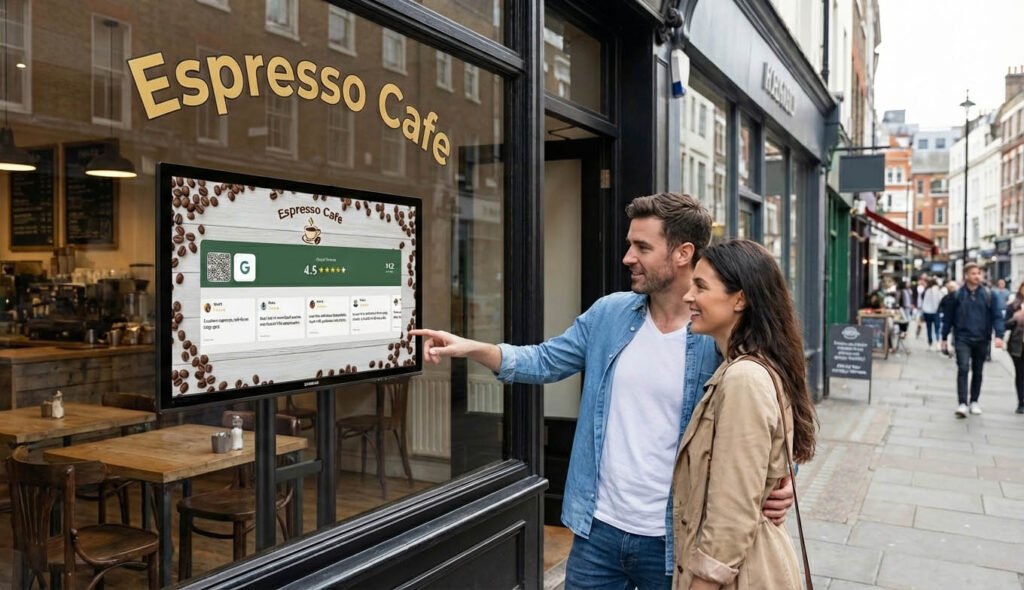
Displaying your Google Reviews prominently is one of the highest-impact things you can do.
2. Follower Counts
Large follower counts signal popularity and trustworthiness. Research shows accounts with more followers are perceived as more credible, more interesting, and more worth following.
This creates a virtuous cycle: more followers attract more followers. The rich get richer.
3. User Numbers
“Join 50,000 customers” or “10,000 businesses trust us” — these numbers work because they answer an unspoken question: “Is this legitimate?”
When tens of thousands have already made a choice, it feels safer to do the same.
4. Real-Time Activity
“15 people are viewing this right now” or “3 purchased in the last hour” — real-time social proof creates urgency while demonstrating popularity.
Dynamic, live information feels more authentic than static claims.
5. Visual Social Proof
Seeing is believing. Photos of real customers, user-generated content, and visible displays of your follower counts are more convincing than written claims.
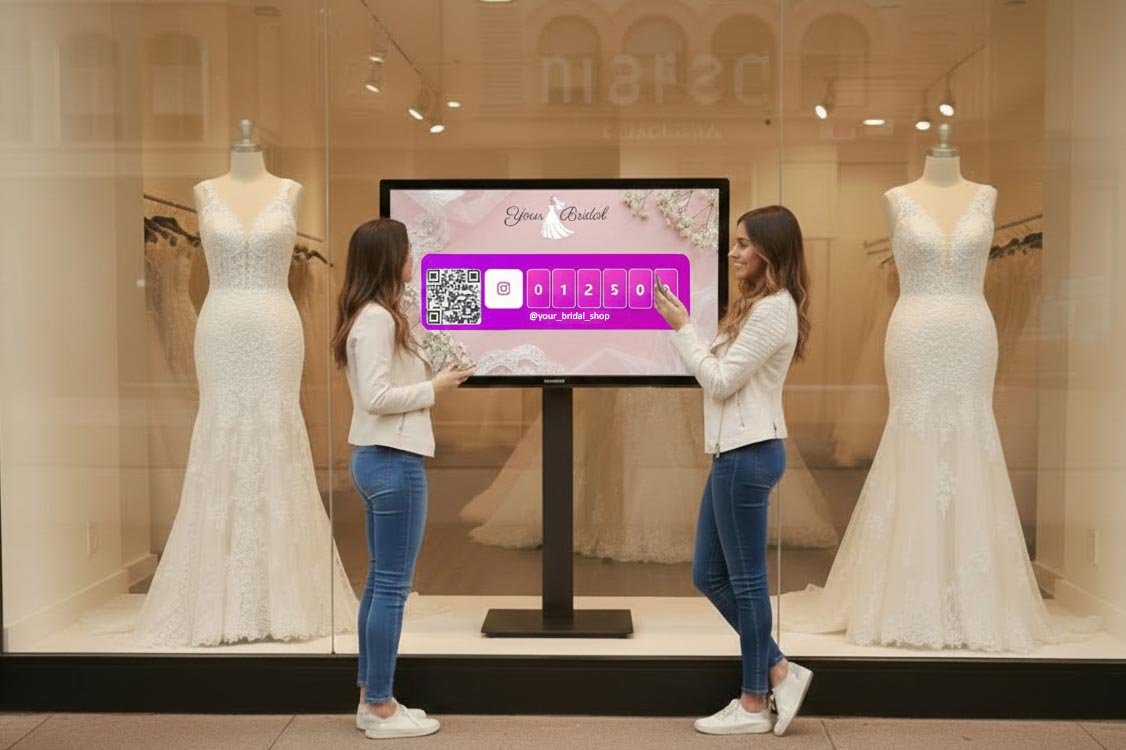
This is why live social media counters work better than printed signs. A real-time number is harder to fake and more compelling to watch.
When Social Proof Doesn’t Work
Social proof isn’t magic. It can fail or even backfire in certain situations.
Low Numbers Hurt More Than No Numbers
Displaying “2 followers” or “3 reviews” is worse than showing nothing. Small numbers signal unpopularity and make people question why nobody else has engaged.
If your numbers are low, focus on building them before displaying them prominently.
Negative Social Proof Backfires
Messages like “Most people don’t recycle” or “Many customers forget to tip” actually increase the unwanted behavior. They normalize it.
If you’re highlighting a problem, you’re inadvertently telling people that many others do it — making it seem acceptable.
Irrelevant Social Proof Falls Flat
Social proof from people unlike your target audience doesn’t resonate. A teenager doesn’t care that 50,000 retirees use a product. A vegan isn’t swayed by meat-lovers’ reviews.
The most effective social proof comes from people similar to your target customer.
Fake Social Proof Destroys Trust
Bought followers. Fake reviews. Inflated numbers.
Consumers are increasingly savvy at detecting inauthentic social proof. And when they catch it, the damage is severe. Trust, once broken, is nearly impossible to rebuild.
This is why authentic, real-time social proof — actual followers, genuine reviews — always outperforms manufactured metrics.
How to Apply Social Proof to Your Business
So social proof works. The research is clear. But how do you actually use it?
Display Your Numbers Visibly
Don’t hide your follower counts and reviews in a corner. Make them prominent. Display them where customers naturally look — at eye level, near the register, where people wait.
The goal is to turn foot traffic into followers by showing them what others have already done.
Make It Easy to Add to the Numbers
Social proof grows when you make participation effortless. QR codes that lead directly to your Instagram profile. One-tap links to leave a Google review.
Remove every barrier between “I want to follow” and “I followed.”
Keep It Current
Stale social proof loses power. Reviews from 2019 don’t carry the same weight as reviews from last week. A follower count from a printed sign can’t compete with a live, updating number.
Real-time displays maintain relevance and authenticity.
Show Multiple Platforms
Different customers prefer different platforms. Some live on Instagram. Others trust Google Reviews above all else. Many are active on TikTok.
Displaying social proof across multiple platforms ensures you’re reaching everyone — and compounds the effect. If you have 10,000 Instagram followers AND 500 Google Reviews AND 5,000 TikTok followers, that’s more impressive than any single number alone.
Build a System
Random efforts produce random results. The businesses that generate consistent reviews and followers have systems in place.
Automated displays. QR codes at every touchpoint. Reminders built into the customer experience. Social proof that grows on autopilot.
The Bottom Line: Social Proof Works — If You Use It Right
Does social proof work? The evidence is overwhelming: yes.
- 98% of consumers read reviews before buying
- Reviews increase conversions by 270%
- One star rating increase equals 5-9% more revenue
- 92% trust peers over advertising
But knowing social proof works isn’t enough. You have to implement it effectively:
- Display your numbers — follower counts, review ratings, customer totals
- Make it authentic — real numbers, real reviews, real-time updates
- Remove friction — QR codes, direct links, one-tap actions
- Stay current — live displays beat static signs every time
- Build a system — automate collection and display
Social proof isn’t just a marketing tactic. It’s a fundamental driver of human behavior backed by decades of research from the world’s leading institutions.
The only question is whether you’ll use it — or let your competitors use it against you.
Start Displaying Your Social Proof Today
SocialCounters makes it easy to show your live follower counts, Google Reviews, and ratings on any screen. No technical skills required. Setup takes minutes.
Stop hiding your social proof. Start showing it.
Sources
- BrightLocal (2024). Local Consumer Review Survey. https://www.brightlocal.com/research/local-consumer-review-survey/
- Spiegel Research Center, Northwestern University. How Online Reviews Influence Sales. https://spiegel.medill.northwestern.edu/online-reviews/
- Luca, M. (2016). Reviews, Reputation, and Revenue: The Case of Yelp.com. Harvard Business School. https://www.hbs.edu/faculty/Pages/item.aspx?num=41233
- Nielsen (2012). Global Trust in Advertising and Brand Messages. https://www.nielsen.com/insights/2012/global-trust-in-advertising-and-brand-messages-2/
- Leibenstein, H. (1950). Bandwagon, Snob, and Veblen Effects in the Theory of Consumers’ Demand. The Quarterly Journal of Economics. https://www.jstor.org/stable/1882692
- Cialdini, R. (1984). Influence: The Psychology of Persuasion. Harper Business.
