
How to Get More TikTok Followers for Your Local Business
Most advice about TikTok for small businesses is written for people who want to go viral. For a local business, viral is mostly useless.
A video that gets two million views from people in five countries sells you nothing if you run a hair salon in Utrecht. Fifteen hundred views from people who live within ten minutes of your door is worth more than all of it, because some of them will actually show up.
So forget the view counter for a minute. The question is not how to get big. It is how to get known in a radius of about five kilometres, and how to turn the people already standing at your counter into people who watch you every week.
That is a different game, and it is a much easier one.
Why TikTok is still the best place for a small local business
Three things make it different from Instagram, and they all work in your favour.
Your follower count barely matters. TikTok shows a new video to a small test group first, then decides whether to show it to more people based on how they react. An account with forty followers can land thirty thousand views. That does not happen on Instagram, where your reach mostly depends on who already follows you.
Polished content performs worse. On TikTok, something filmed on a phone in bad lighting while you work often beats something a studio made. You already have the only equipment you need, and the thing you are best at is the content.
People search it like a map. Plenty of people under forty now type “best coffee [city]” or “things to do in [neighbourhood]” straight into TikTok instead of Google. Your videos can surface there, and that is local search traffic you are not paying for.
One caveat worth saying out loud: TikTok is slow. Your first month is you learning what your audience responds to. Real business effect usually takes a few months of steady posting. Anyone who tells you otherwise is selling a course.
What to film when you are not an entertainer
You do not have to dance. You do not have to talk to camera if you hate it. The formats below work because people are curious about work they never see.
Your hands doing your job. Bread being shaped. A bouquet being built. A bumper being sanded. A fade being cleaned up. No commentary needed, no face in frame. This is the single easiest category and it never stops working.
The satisfying bit. Every trade has one. Peeling the film off a new panel, the first pass of a pressure washer, icing going smooth, a perfectly straight cut. If a part of your work is pleasant to watch, that is a video.
A day in your life. Opening up, the rush, the thing that went wrong, closing. This makes a business feel like people instead of a logo, which is what makes someone choose you over the identical shop down the road.
The question you answer ten times a week. “How often should I do this.” “Why is that one twice the price.” “What do I ask before hiring someone like you.” You know the answers by heart. Each one is ninety seconds of content and it makes you look like the expert you are.
Things that only make sense here. Local weather complaints, a landmark in the background, the football result, a joke only people from your town get. These videos travel less far, which is exactly what you want.
Trends are optional. Use a trending sound when it fits your work, skip it when it does not. Forcing your business into a format never looks good.
The first second decides everything
TikTok users scroll at speed. You get about one second to stop the thumb.
What stops people: something already moving, a short line of text that raises a question, a visual that does not make sense yet, saying the name of your town out loud.
What does not: a logo animation, a slow walk toward the camera, “hi guys, welcome to our TikTok”, and any kind of introduction at all.
After that, keep it to one idea per video. Show it rather than explain it. Put a text overlay on screen, because a lot of people watch with sound off. Mention where you are at some point, naturally, because that is how the right viewers know you are near them.
End with one thing you want them to do. One. “Come try this”, “follow for more of these”, “comment if you want the full version”. Three calls to action in one video is the same as none.
How often, and how to survive it
Three videos a week is the floor. One a day is better. More than that and the quality drops, which hurts you more than the extra post helps.
Nobody can film daily for long, so batch it. Pick two hours in your quietest moment of the week and shoot seven to ten clips in one go. You already have the setting and the apron on. Editing and posting is then fifteen minutes a day.
Post when your customers are on their phone rather than when a blog tells you to. For most local businesses that means early morning, around lunch, and between seven and ten in the evening. Watch your own analytics after two weeks and follow those instead.
Three to five hashtags is plenty: one broad one, one for your town, one for your trade. Thirty hashtags does not help and makes you look desperate.

Turning viewers into people who walk in
This is where most local accounts stall. The views go up, the shop stays as quiet as before.
Make your profile a shop front. Business name as the username so people can find you, your logo or storefront as the photo, and a bio that says what you do, where you are and when you are open. A link to booking or ordering, not to a homepage that makes people hunt.
Show the outside of your building, often. People need to recognise the door. Film the street, the sign, where to park. It sounds dull. It is the thing that converts.
Say where you are in the video. “Here in [town]” is a tiny line that tells half the viewers you are irrelevant to them and the other half that you are around the corner. Both are useful.
Give people a reason to come now. “We are open until nine”, “mention this video for a free extra shot”, “we have two slots left Thursday”. Vague invitations get vague results.
Ask how people found you. One sentence at the counter. It is the only honest way to know whether any of this is working.
The group you keep forgetting: the people already in your shop
You are spending hours trying to reach strangers online while the easiest followers you will ever get are standing in front of you, holding their phone, waiting.
Almost none of them follow you. Not because they do not want to, but because remembering a handle, opening the app, typing it correctly and searching is five steps too many. People forget before they reach the car.
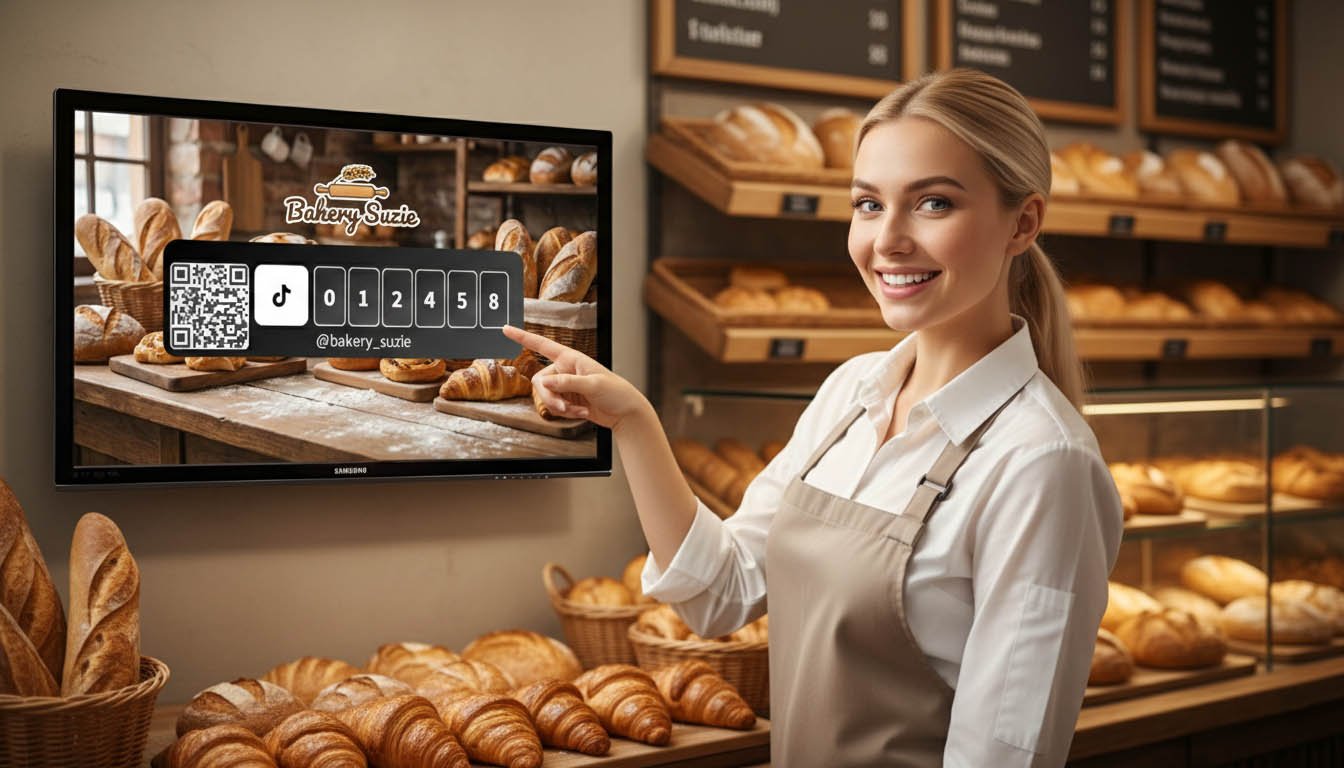
A screen with your live TikTok follower count and a QR code next to it removes every one of those steps. They scan, they tap follow, it took ten seconds, and they never had to remember anything.
It also does something a sticker cannot. A number that is visibly real tells a customer there is something worth joining, and a number that went up since their last visit says the place is alive.
Full disclosure: this is our product, so of course we think it belongs in your shop. The honest test costs nothing. Make a free code with our follow us QR code generator, tape it next to the till for a week and watch what happens. If a piece of paper does nothing, a screen will not fix it. If it does, you know the next step is worth it.
For the thinking behind why a visible number changes behaviour, read the science of social proof. For the practical version with placement and wording, how to turn foot traffic into social media followers covers it, and why follow us stickers and Google review signs are dead explains why the old paper sign stopped working.
What to actually measure
Followers and views feel good and tell you almost nothing.
Watch these instead:
- Profile visits. People who liked the video enough to check who you are.
- Link taps. People moving toward booking or ordering.
- Scans on your in-store code. Your dashboard counts those, so you know whether the screen is doing anything.
- People who mention it. “I saw you on TikTok” is the metric that pays your rent.
A reasonable timeline: the first month is learning, months two and three are refining, and somewhere after that you should start hearing your own videos mentioned at the counter. If after four months of steady posting nobody has mentioned it once, your content is reaching the wrong town, not the wrong platform.
A month to get started
Week one. Set up the business account, write the bio with your town in it, add the link. Follow ten local businesses that are good at this and steal their structure, not their jokes.
Week two. Batch film ten clips. Post one a day. Reply to every comment in the first hour, because early engagement is what tells the algorithm to keep going.
Week three. Put a code at the till. Tell your staff to mention it once per customer, in one sentence, not as a speech.
Week four. Look at which three videos did best and make four more like them. Drop whatever did nothing, no matter how proud you were of it.
That is it. The equipment is in your pocket, the content is your working day, and the people most likely to follow you are already in the building.
