
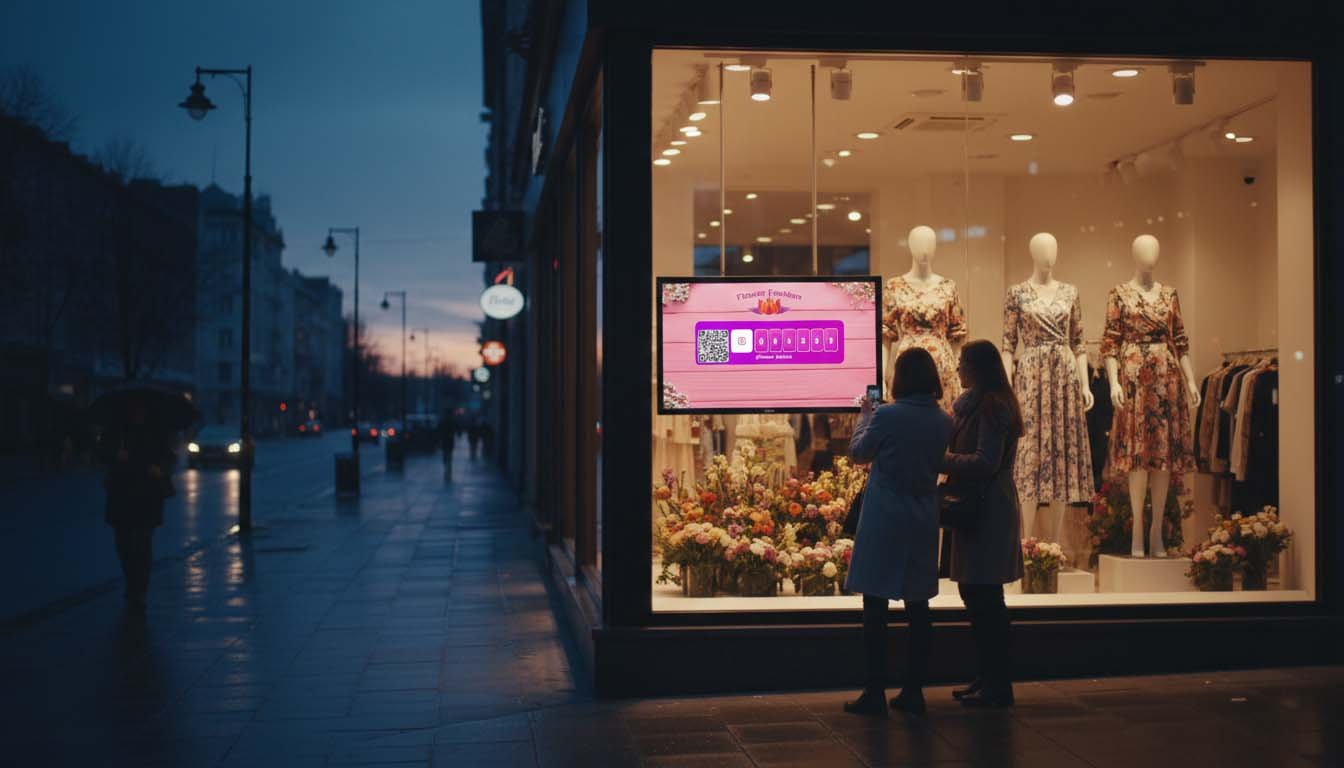
The Science of Social Proof: Why Businesses That Display Social Validation Outperform Those That Don’t
In 1984, psychologist Robert Cialdini published Influence: The Psychology of Persuasion — a book that would become one of the most cited works in marketing history.
Among his six principles of persuasion, one stood out as particularly powerful: social proof.
Cialdini defined social proof as the psychological phenomenon where people assume the actions of others reflect correct behavior. In simpler terms: we look to what others do to decide what we should do.
Four decades later, this principle isn’t just academic theory. It’s measurable, quantifiable, and directly tied to business revenue.
This article examines the research behind social proof — and why restaurants, retail stores, and physical locations that display social validation consistently outperform those that don’t.
What the Research Says: Social Proof by the Numbers
98% of Consumers Read Reviews Before Choosing a Local Business
According to BrightLocal’s 2024 Local Consumer Review Survey — an annual study tracking consumer behavior around online reviews — 98% of consumers read online reviews for local businesses.
This isn’t a niche behavior. It’s nearly universal.
The same study found:
- 87% of consumers used Google to evaluate local businesses in 2023
- 76% regularly read online reviews when browsing for local businesses
- Only 2% of consumers never read reviews
Source: BrightLocal, “Local Consumer Review Survey 2024”
The implication is clear: if your reviews aren’t visible, you’re invisible to the vast majority of potential customers.
Displaying Reviews Can Increase Conversion by 270%
Researchers at the Spiegel Research Center at Northwestern University conducted a comprehensive study analyzing 57,000 reviews across multiple product categories.
Their findings were striking:
- Displaying reviews increases conversion rates by up to 270%
- Products with reviews are 270% more likely to be purchased than products without
- Even negative reviews increase conversion compared to no reviews at all
- The impact is strongest for higher-priced items and lesser-known brands
Source: Spiegel Research Center, Northwestern University, “How Online Reviews Influence Sales” (2017)
For physical locations, this translates directly: visible social proof converts browsers into customers.
A One-Star Rating Increase Leads to 5-9% Revenue Growth
Harvard Business School professor Michael Luca conducted landmark research on the relationship between Yelp ratings and restaurant revenue.
His study, analyzing data from Washington state restaurants, found:
- A one-star increase in Yelp rating leads to a 5-9% increase in revenue
- The effect is driven by consumer behavior: higher ratings lead to more customers choosing that restaurant
- Independent restaurants benefit most; chain restaurants (with established reputations) see smaller effects
Source: Michael Luca, Harvard Business School, “Reviews, Reputation, and Revenue: The Case of Yelp.com” (2016)
This research quantifies what business owners intuitively know: ratings directly impact revenue. The question isn’t whether reviews matter — it’s whether you’re making them visible.
92% of Consumers Trust Peer Recommendations Over Advertising
Nielsen’s Global Trust in Advertising Study surveyed more than 28,000 consumers in 56 countries about their trust in various information sources.
The results challenge traditional marketing assumptions:
- 92% of consumers trust recommendations from friends and family above all forms of advertising
- 70% trust online consumer opinions — even from strangers
- Only 33% trust traditional banner ads
- Trust in advertising has declined while trust in peer recommendations has grown
Source: Nielsen, “Global Trust in Advertising” (2021)
This explains why social proof outperforms advertising: it’s not perceived as marketing. It’s perceived as truth.
88% of Consumers Trust Online Reviews as Much as Personal Recommendations
BrightLocal’s research further confirms this trust dynamic:
- 88% of consumers trust online reviews as much as personal recommendations
- 79% say they trust online reviews as much as recommendations from friends and family
- Consumers read an average of 10 reviews before feeling able to trust a business
Source: BrightLocal, “Local Consumer Review Survey 2024”
Online reviews have effectively become word-of-mouth at scale. Each review is a personal recommendation visible to thousands of potential customers.
53% of Consumers Expect Businesses to Respond to Negative Reviews Within a Week
The same BrightLocal study found that social proof isn’t just about accumulating reviews — it’s about demonstrating engagement:
- 88% of consumers are likely to use a business that responds to all reviews
- 53% expect a response to negative reviews within one week
- 33% expect a response within 3 days or less
Source: BrightLocal, “Local Consumer Review Survey 2024”
Visible engagement with reviews is itself a form of social proof — it demonstrates that a business values customer feedback.
The Psychology: Why Social Proof Works
The research is clear on what happens. But why does social proof work so effectively?
Informational Social Influence
When we’re uncertain about a decision, we look to others for guidance. Psychologists call this informational social influence.
Choosing a restaurant, salon, or shop involves uncertainty:
- Will the food be good?
- Will the haircut be what I want?
- Will this product be worth the money?
Reviews and follower counts reduce uncertainty by showing what others have decided. If 300 people have reviewed a restaurant positively, the risk of a bad experience feels lower.
The Bandwagon Effect
First documented by economist Harvey Leibenstein in 1950, the bandwagon effect describes our tendency to do something primarily because others are doing it.
The effect is amplified by visible numbers:
- “14,000 followers” signals popularity
- “4.8 stars from 312 reviews” signals quality
- Growing numbers signal momentum
We don’t just want to make good choices — we want to make choices that others validate. Large numbers provide that validation.
Reduced Cognitive Load
Decision-making requires mental energy. Psychologist Barry Schwartz, in The Paradox of Choice, documented how too many options lead to decision paralysis.
Social proof simplifies decisions by providing shortcuts:
- “Most reviewed” = probably good
- “Highest rated” = probably safe
- “Most followed” = probably worth attention
Rather than evaluating every option independently, consumers use social proof as a filter. The business with visible social proof gets chosen; the one without gets skipped.
The Zero-Risk Bias
Research on consumer psychology shows that people are disproportionately drawn to options that feel “safe.”
Social proof makes choices feel safe:
- Others have tried this and approved
- If something goes wrong, I’m not alone in being deceived
- Popular choices carry less social risk
A restaurant with 500 reviews feels safer than one with 5 — even if the small one might be better.
Why Physical Locations Have an Untapped Advantage
Here’s what makes this research particularly relevant for restaurants, salons, and retail shops:
You have foot traffic.
Online businesses must work hard to display social proof where potential customers see it. They buy ads, optimize search rankings, and design landing pages.
Physical locations have customers already present — captive audiences who are already interested, already browsing, already there. The opportunity to turn foot traffic into social media followers is enormous — if you use it.
Yet most physical locations hide their social proof:
- Reviews exist on Google, but aren’t displayed in-store
- Follower counts exist on Instagram, but aren’t visible at checkout
- Social validation exists, but customers have to search for it
The research is clear: displaying social proof increases conversion. Physical locations have conversion opportunities walking through the door every day.
The question is whether you’re using them.
Applying the Research: Making Social Proof Visible
The gap between research and application is where most businesses fail.
They know reviews matter. They know social proof works. But they don’t systematically display it where customers can see it.
Traditional Methods: Limited Effectiveness
Static signage: “We’re on Google!” doesn’t show your rating. It makes a claim without providing proof. In fact, traditional “Follow Us” stickers and Google Review signs are increasingly ineffective in 2026.
Review printouts: Dated. Static. Often ignored because they look like marketing material.
Social media handles: “Follow us @business” provides no reason to follow. There’s no visible proof of popularity.
These methods fail because they don’t leverage the psychology. They ask without proving.
The Display-Based Approach: Aligned With Research
The research points to specific elements that drive action:
✅ Visible numbers (follower counts, review counts)
✅ Ratings and stars (quality signals)
✅ Recency (recent reviews, live updates)
✅ Easy verification (QR codes to confirm authenticity)
A live display combines all of these:
- Shows actual follower counts (bandwagon effect)
- Displays real ratings (reduced uncertainty)
- Updates in real-time (recency and momentum)
- Includes QR codes (verification and action)
This is where tools like Social Counters translate research into practice. If you’re looking for a complete Google review system for restaurants, salons, or shops, this approach delivers.
How SocialCounters Applies the Research
Social Counters displays your live social proof on any screen in your business:
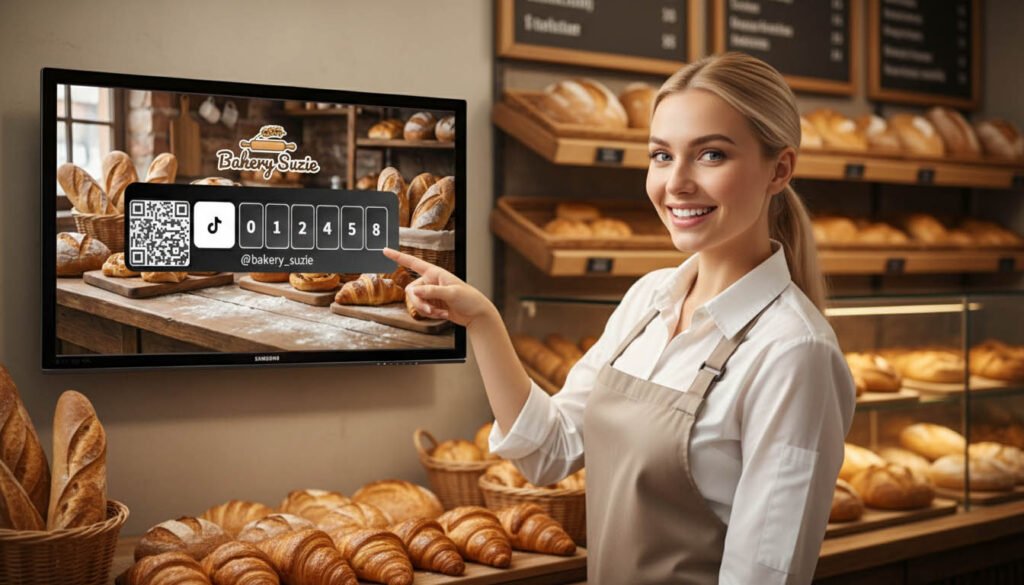
Live follower counts: Instagram, TikTok, Facebook, YouTube — updating in real-time. When customers see “14,847 followers” tick to “14,848,” they see proof of momentum.
Google Reviews display: Your actual rating and review count, visible where customers stand. The research says 98% check reviews — now they see yours without searching.
QR codes for instant action: The Spiegel Research Center found reviews increase conversion by 270%. But customers need a path to action. QR codes remove friction entirely.
Social proof loop: The research shows displaying reviews generates more reviews. Social Counters creates this loop automatically — visible proof encourages contribution.
For restaurants, salons, and retail shops, this means applying decades of psychological research without hiring consultants or redesigning operations.
Case Application: Social Proof in Different Business Types
Restaurants
The research says:
- One-star rating increase = 5-9% revenue increase (Harvard)
- 98% of consumers check reviews before choosing (BrightLocal)
- Trust in peer recommendations exceeds trust in advertising (Nielsen)
The application: Display your Google rating in the waiting area and on table tents. Customers waiting for a table or for food have time to notice — and leave their own review via QR code.
The social proof loop: satisfied diners see your rating, leave a review, rating improves, more diners trust you. Learn more about how to get customers to leave reviews on Google for your restaurant.
Salons and Barbershops
The research says:
- Reviews increase conversion by up to 270% (Spiegel Research Center)
- 88% trust reviews as much as personal recommendations (BrightLocal)
- Visible numbers trigger the bandwagon effect (Leibenstein)
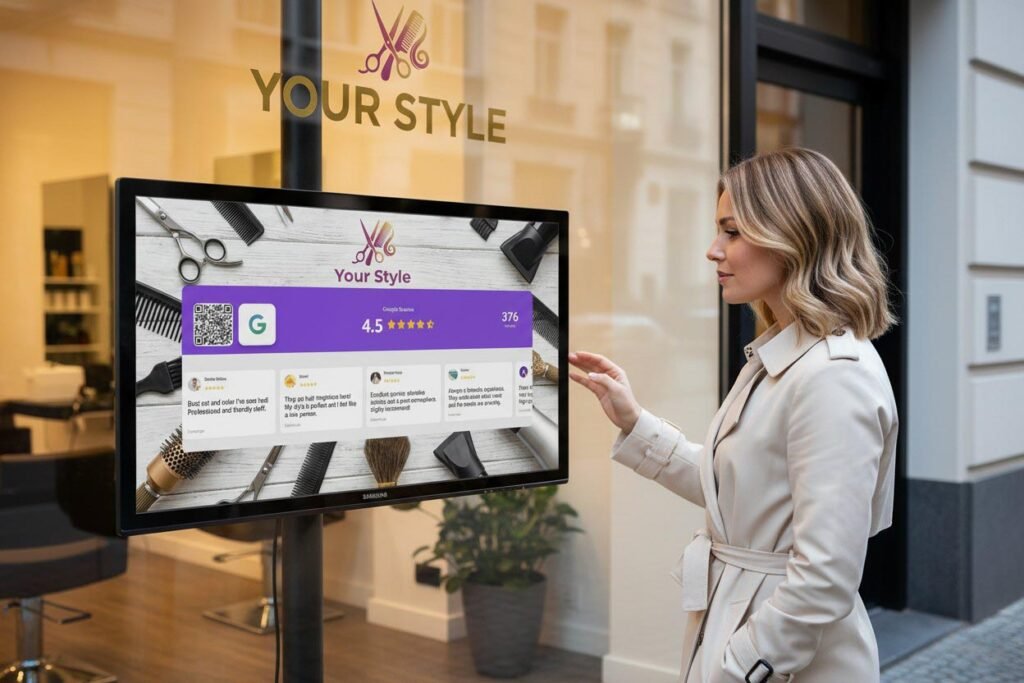
The application: Display your follower count and rating at styling stations. Clients sit for 30-90 minutes — captive audience. Processing time (waiting for color) is perfect for scanning QR codes and leaving reviews.
Before/after transformations on Instagram + visible follower count = proof of expertise.
Retail Shops
The research says:
- Higher-priced items see the strongest review impact (Spiegel)
- Social proof reduces decision paralysis (Schwartz)
- 70% trust online consumer opinions (Nielsen)
The application: Display your Google rating and Instagram following behind the checkout counter. Customers making purchase decisions see immediate social validation.
For higher-priced items, visible reviews reduce the uncertainty that prevents purchase.
Any Physical Location
The principle applies universally:
- Identify where customers wait or linger
- Display social proof at those points
- Include QR codes for immediate action
- Let the research-backed psychology do the work
Measuring Results: What to Track
If you implement display-based social proof, how do you measure impact?
Review Velocity
Track how many new reviews you receive per week/month before and after implementation.
The research suggests visible reviews generate more reviews. A jump from 5 reviews/month to 15 reviews/month indicates the social proof loop is working.
Rating Trend
More reviews from satisfied customers (prompted at the right moment) should maintain or improve your average rating.
Monitor for rating increases following implementation.
Follower Growth
Compare monthly new followers before and after displaying your live counts.
Businesses using Social Counters report 3-5x more followers than those relying on static signage.
Revenue Correlation
The Harvard research shows direct rating-to-revenue correlation. Track whether rating improvements correlate with revenue increases.
This is the ultimate measure: does visible social proof drive business results?
The Research Is Clear. The Application Is Simple.
Decades of research from Harvard, Northwestern, Nielsen, and others points to the same conclusion:
Social proof drives buying decisions.
- 98% of consumers read reviews (BrightLocal)
- Reviews increase conversion by up to 270% (Spiegel Research Center)
- One-star improvement increases revenue 5-9% (Harvard)
- 92% trust peer recommendations over advertising (Nielsen)
The businesses that win aren’t necessarily the best — they’re the ones that display proof of being good.
For restaurants, salons, retail shops, and every physical location:
Your reviews exist. Your followers exist. Your social proof exists.
The question is whether it’s visible where customers can see it.
Social Counters makes it visible. Live follower counts. Real Google ratings. Instant QR codes. On any screen.
The research says it works. The application takes minutes.
References
- Cialdini, R.B. (1984). Influence: The Psychology of Persuasion. Harper Business. Wikipedia Overview
- BrightLocal. (2024). “Local Consumer Review Survey 2024.” https://www.brightlocal.com/research/local-consumer-review-survey/
- Spiegel Research Center, Northwestern University. (2017). “How Online Reviews Influence Sales.” https://spiegel.medill.northwestern.edu/online-reviews/
- Luca, M. (2016). “Reviews, Reputation, and Revenue: The Case of Yelp.com.” Harvard Business School Working Paper. https://www.hbs.edu/faculty/Pages/item.aspx?num=41233
- Nielsen. (2021). “Global Trust in Advertising.” https://www.nielsen.com/insights/2021/trust-in-advertising-study/
- Leibenstein, H. (1950). “Bandwagon, Snob, and Veblen Effects in the Theory of Consumers’ Demand.” The Quarterly Journal of Economics, 64(2), 183-207. https://www.jstor.org/stable/1882692
- Schwartz, B. (2004). The Paradox of Choice: Why More Is Less. Harper Perennial. TED Talk Summary
