
Phone Repair Shop Marketing. How to Build Trust and Get More Customers
Your customer is not buying a screen replacement. They are handing a stranger the one object that holds their photos, their messages, their bank app and every password they own, and then walking away from it.
That is the actual transaction. Everything else is details.
Which is why the usual repair shop marketing does nothing. “Fast, affordable, friendly service” is written on the window of every shop in the country, including the ones that do swap your original screen for a cheap copy. Saying it proves nothing, so it changes nothing.
The shops that fill up are not always the best technicians. They are the ones who answered the customer’s three unspoken questions before being asked.
The three questions behind every hesitation
Stand at your counter and listen to what people are really asking.
“Will you look through my phone?” Nobody says this out loud. Everybody thinks it. One video about a repair shop copying someone’s photos does damage across the whole trade for months.
“Will this hold, or will it crack again in a month?” They have either had a bad repair or heard about one. Cheap parts are the industry’s reputation problem and your customer knows the phrase “original quality” means nothing on its own.
“Will the price change once you have my phone?” The fear of being quoted sixty and charged a hundred and twenty, with your device already in pieces on a bench.
Every effective thing below is just one of those three fears being removed. If a marketing idea does not remove one of them, it is decoration.
Fear one, my data
Most shops never mention privacy, which is strange, because it is the loudest worry in the room. Saying nothing reads as having nothing to say.
Put a policy on the wall, in plain language. Not a legal page nobody reads. Five lines:
We never open your photos, messages or apps. We repair at the counter where you can watch. We ask you to back up and sign out first, for your own peace of mind. Our technicians have signed a privacy agreement. Your phone is never left unattended out of sight.
Repair in view where you can. “You can watch if you want” is one of the strongest sentences in this business. Almost nobody stays to watch. Everybody relaxes when they hear they could.
Train the sign-out line. “For your own privacy, back up and sign out of your accounts before we start. We never touch your personal data, but this way you do not have to take our word for it.”
That last half sentence is the whole trick. You are not asking them to trust you. You are removing the need to.
Fear two, will the repair hold
This one is answered with proof, not promises.
Show the part before you fit it. Take it out of the packaging in front of them. Say what it is and what grade it is. A customer who has seen the new screen in its box stops wondering what went in.
Give a warranty that costs you something to say. Ninety days is the minimum anyone should offer. Six to twelve months turns it into marketing, because the shop down the road is not saying it. If your repairs are good, a longer warranty costs almost nothing and takes the question off the table entirely.
Show your work where people look. Phone repair is unusually photogenic. A shattered screen next to a perfect one needs no caption. Time lapses of a screen swap, the film peeling off, a water damaged phone coming back on. Post those steadily and your profile becomes a portfolio: hundreds of repairs, visibly done by the same careful hands.
There is a second thing those posts prove without saying it. Volume. A shop with two hundred repair posts has clearly done this before. That is the fear of “am I the practice phone” gone.
Ask for the fifteen second video. After a repair that went well: “Would you mind saying in a few words what was wrong and how it went? It helps other people trust us.” Most happy customers say yes. A real face saying “completely shattered, fixed in half an hour” does what no written claim can, because it cannot be invented.
Fear three, the price will change
Hidden costs destroy trust faster than a slow repair ever will.
A price board, visible from the door. Model, repair, price, and the line that matters most underneath:
All prices include parts, labour and a 6-month warranty. The price you are quoted is the price you pay.
Quote in writing before you start. What is wrong, which part goes in, the total, and roughly how long. It takes thirty seconds and it quietly says you are not the shop that discovers extra problems halfway.
Say the escape route out loud. “Diagnosis is free and you are under no obligation. If we find something else, we call you before we touch it.” People relax when they know they can walk away. The ones who can walk away are the ones who stay.
The thing on your counter does more work than your ads
Here is where most shops leave the easiest win on the table.
You probably have a good Google rating. It sits on the internet, where a nervous customer has to go looking for it, which they will not do while standing in front of you. The counter in front of them shows a card display and a price list.
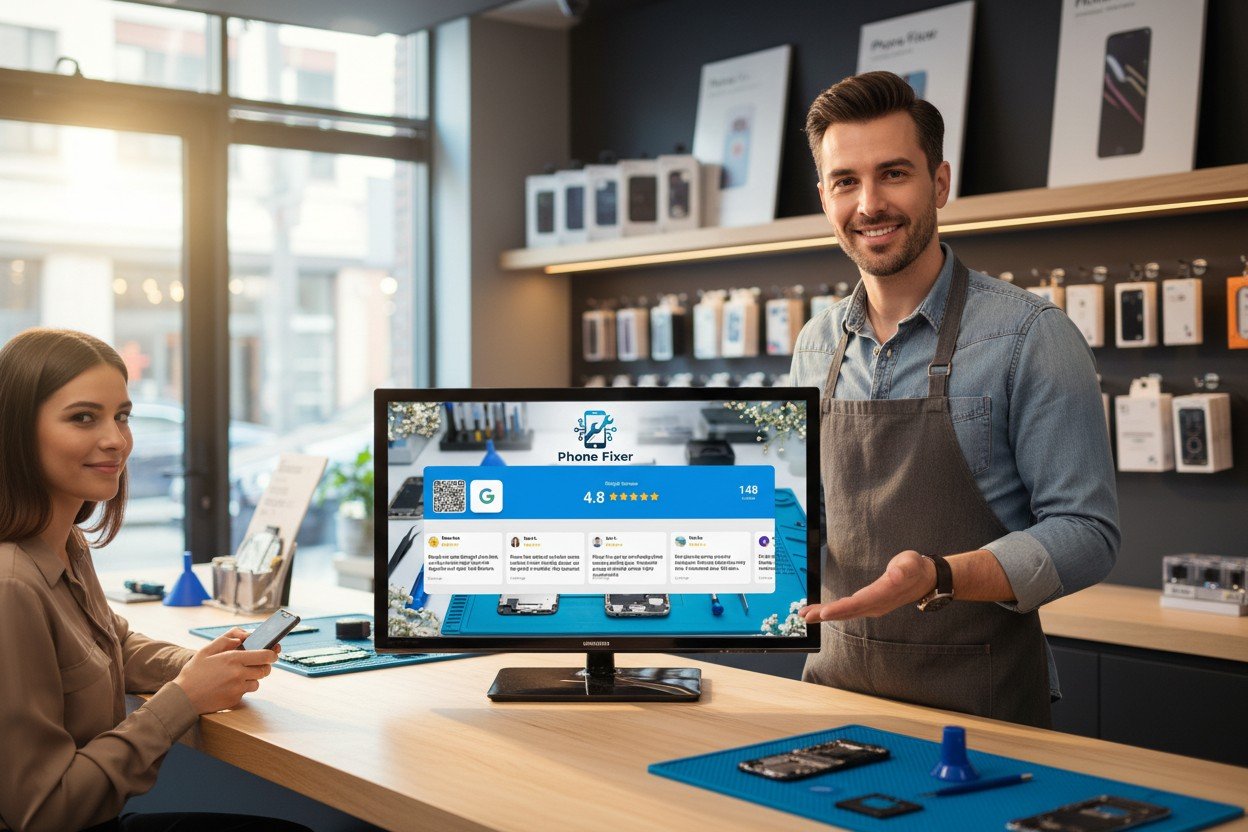
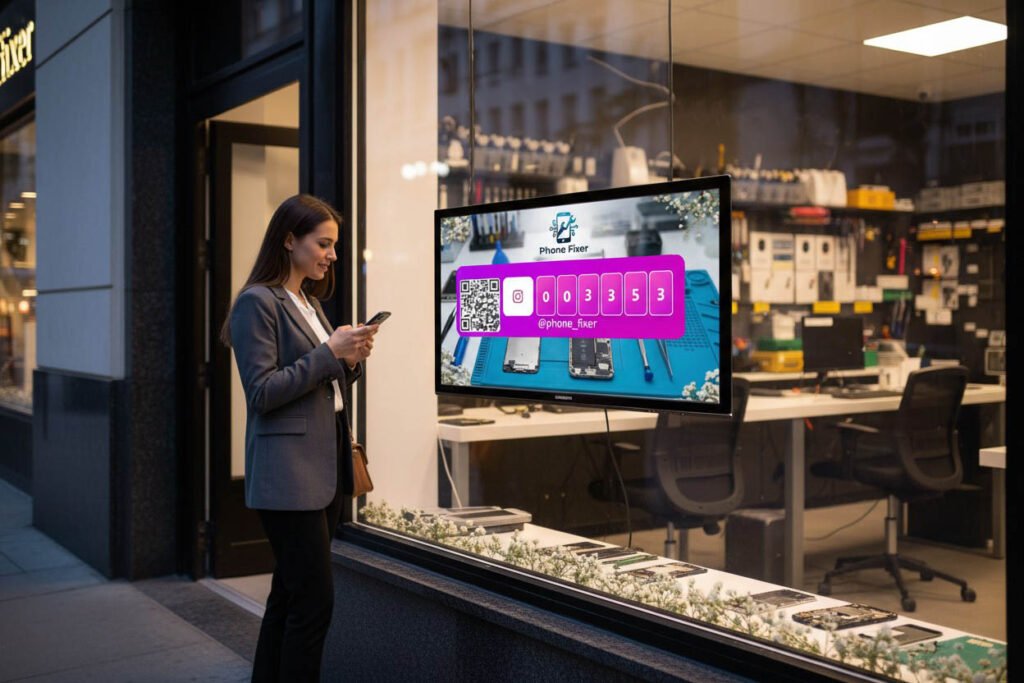
Put the rating where they are already looking. A screen behind the counter showing your live Google rating and the number of reviews changes the first ten seconds of every visit. Hundreds of people did this before me, and they came back to say it went well.
It answers all three fears at once, which is why it beats any single sign you could hang. People do not write reviews about the technical quality of a digitiser. They write “they were careful”, “price was exactly as quoted”, “still perfect six months later”. That is your privacy policy, your warranty and your pricing promise, in your customers’ words rather than your own.
Three details decide whether it works:
- Height and placement. Behind the counter at eye level, or in the window facing the street so it works before anyone comes in. A screen below waist height may as well be off.
- A QR code next to it. Waiting customers can read the actual reviews, and satisfied ones can leave theirs in thirty seconds without searching for your shop first.
- It has to be live. A printed “4.9 stars” sign is a claim. A number that updates when a new review lands is proof, and regulars notice when it goes up.
Full disclosure: SocialCounters is our product, so of course we think a live rating belongs on your counter. The cheap way to test the idea first is a QR code on the counter for a week. Make one with our Google review QR code generator, count what comes in, and decide after that. If a piece of paper does nothing for you, a screen will not rescue it.
Ask for the review at the only moment that works
Reviews are the raw material for everything above, and most shops ask at the wrong time.
The moment is when you hand the phone back and they see it working. Relief, surprise, a small bit of joy. Thirty seconds later they are out the door and that feeling is gone for good.
The line is short: “You are all set. If you have half a minute, a Google review really helps us. The code is right here.”
What not to do: email three days later, ask before the repair is confirmed working, offer a discount for a review, which breaks Google’s rules and can get your reviews removed, and never ask someone whose repair went badly. Fix that first, properly, and the review will come later on its own.
More on timing and wording in how to get customers to leave reviews on Google, and the reasoning behind visible numbers in the science of social proof.
The boring online work that still decides who walks in
Someone with a cracked screen types “phone repair near me” and picks from the first three results. If you are not there, nothing else on this page matters.
Fill in your Google Business Profile completely. Every service, real opening hours, photos of the actual shop and the actual bench, before and after shots. Reply to every review, including the bad ones, calmly. A half empty profile reads as a business that might be gone next month.
Keep your website simple and honest. Location, hours, prices, reviews, photos of your real shop and real people, and it must work on a phone, because every single visitor is holding a broken one.
Make a page per repair and per area. “iPhone screen repair in [city]” will always beat a single page that lists everything you do.
Keep your name, address and phone number identical everywhere. Google, Apple Maps, Bing, directories. Mismatched details quietly hurt your local ranking.
What this adds up to
Customers do not pick the cheapest shop, and they do not pick the fastest. They pick the one that feels least risky while they are standing there holding a broken phone.
Remove the data fear by saying the thing nobody says. Remove the quality fear with visible parts, real warranties and a feed full of your own work. Remove the price fear with a board on the wall and a quote in writing. Then put the proof that others trusted you where people actually look, instead of leaving it on a profile page they will never open.
Start with the one that takes the least effort: get your rating in front of people at the counter, and ask for the review at the moment the phone lights up.
