The Science of Social Proof: Why Businesses That Display Social Validation Outperform Those That Don’t
IIn 1984, a psychologist named Robert Cialdini wrote a book called Influence. You’ve probably heard of it, or at least heard people reference it. It became one of those books that marketing people won’t shut up about.
But there’s a reason it stuck around. Cialdini identified something that feels obvious once you see it: people look at what others do before deciding what they should do.
He called it social proof. And forty years later, we have actual data on how powerful it really is.
The Numbers Are Kind of Ridiculous
I’ll just throw some stats at you. These come from actual research, not marketing fluff.
BrightLocal does an annual survey on how consumers use reviews. Their 2024 version found that 98% of people read online reviews before choosing a local business. Ninety-eight percent. That’s basically everyone except your uncle who still pays for everything in cash.
Same survey: 87% used Google specifically to evaluate local businesses. Only 2% said they never read reviews at all.
So when someone says “reviews don’t matter for my business,” they’re probably wrong.
That 270% Conversion Number
Northwestern University’s Spiegel Research Center did a big study analyzing 57,000 reviews across different products. The headline finding gets quoted a lot: displaying reviews can increase conversion by up to 270%.
That sounds made up. But here’s what they actually found.
Products with reviews were dramatically more likely to be purchased than products without any reviews. Even negative reviews helped compared to no reviews at all. The effect was strongest for expensive items and brands people hadn’t heard of.
Makes sense when you think about it. If you’re about to spend $300 on something from a company you’ve never bought from, you want to know someone else tried it first.
For physical locations, this translates pretty directly. Visible proof converts browsers into buyers.
The Harvard Yelp Study
Michael Luca at Harvard Business School looked at Washington state restaurants and their Yelp ratings. His finding: a one-star increase in rating led to 5-9% more revenue.
Not a little bump. A meaningful jump in actual money.
The effect was bigger for independent restaurants than chains. Makes sense too. Chains already have brand recognition. If you see a Chili’s, you know what you’re getting. But a random independent spot? You’re going to check the reviews.
This research quantifies what restaurant owners feel in their gut. Higher ratings bring more customers. Lower ratings lose them.
People Trust Strangers More Than Ads
Nielsen surveyed 28,000 consumers across 56 countries about who they trust. The results probably won’t surprise you.
92% trust recommendations from friends and family above all advertising. Fair enough. But 70% also trust opinions from random strangers online. Only 33% trust banner ads.
Think about that. A stranger’s opinion carries more weight than your carefully crafted marketing. That’s why review sites work. That’s why “4.8 stars from 312 reviews” matters more than “Award-winning local favorite!”
One is proof. The other is a claim.
Why This Actually Works
The research tells us what happens. But the why is interesting too.
When we’re uncertain about something, we look to other people. Psychologists call it informational social influence. Choosing a restaurant involves risk. Will the food be good? Will I waste money? Will my date judge me for picking a bad spot?
Reviews reduce that uncertainty. If 300 people said the pasta is good, the risk feels lower.
There’s also the bandwagon effect. An economist named Harvey Leibenstein documented it back in 1950. We want to do what others are doing. Not because we’re sheep, but because popular choices feel safer.
“14,000 followers” signals something. “4 followers” signals something else entirely.
And then there’s decision fatigue. Barry Schwartz wrote a whole book about how too many choices paralyze us. Social proof gives shortcuts. Highest rated? Probably fine. Most reviewed? Probably safe. We use other people’s decisions to avoid making our own from scratch.
The Weird Thing About Physical Locations
Here’s what struck me about all this research.
Online businesses spend massive amounts making social proof visible. They design landing pages around reviews. They pay for ads highlighting star ratings. They optimize everything to show social validation.
Physical locations? Most of them hide it.
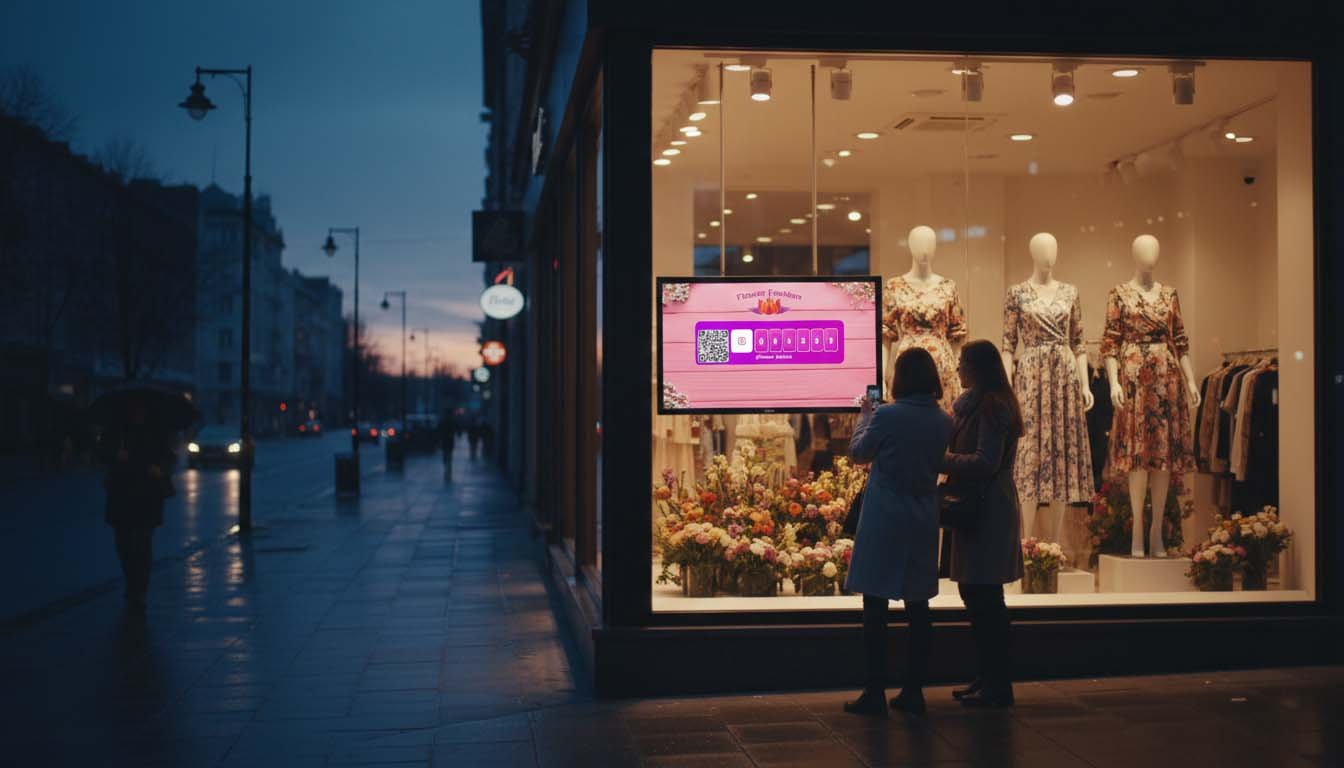
Your Google rating exists. But it’s not displayed in your store. Your Instagram followers exist. But customers have to search for them. The social proof is there, just invisible to the person standing at your counter.
Meanwhile, that person is already interested. Already in your space. Already a warm lead. And you’re making them pull out their phone and search Google to see if other people like you.
Seems backwards.
Why Static Signs Don’t Work
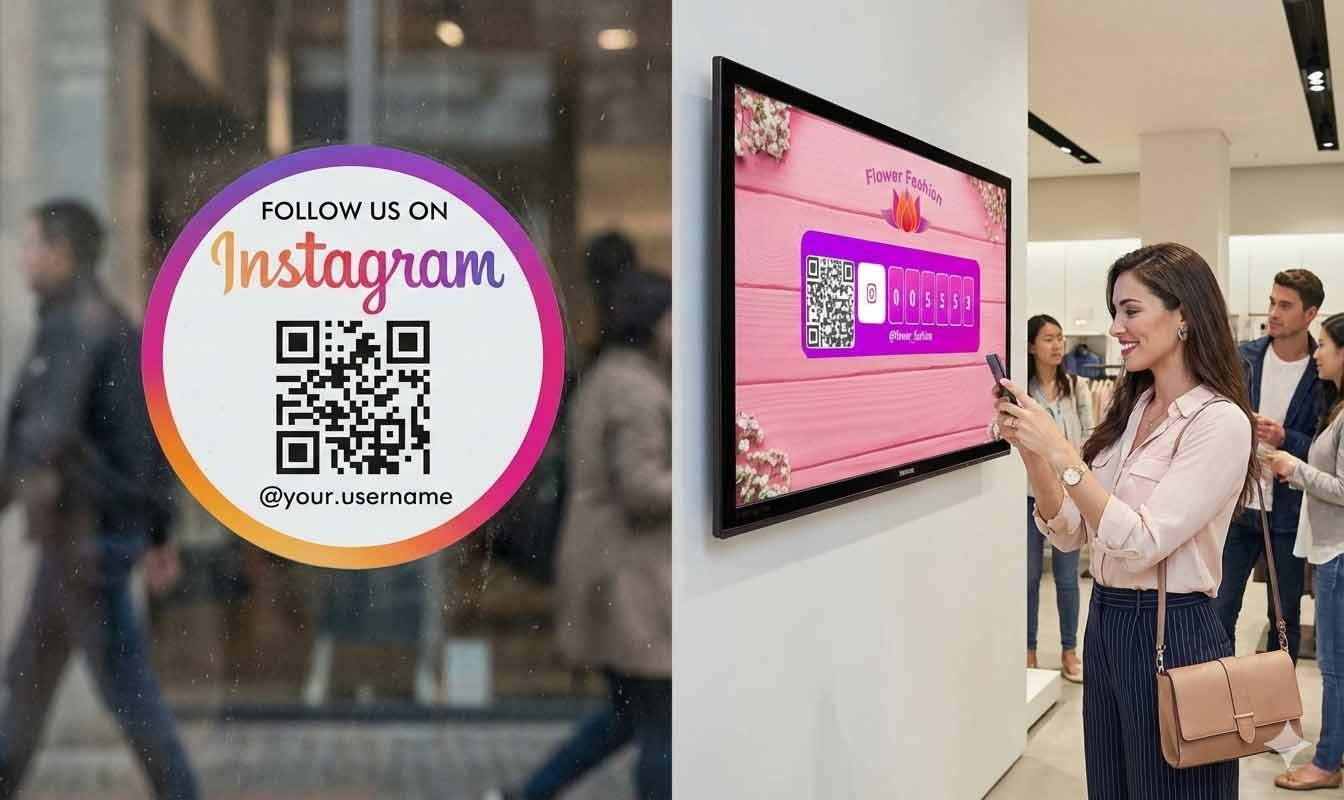
I know what you’re thinking. “We have a sign that says Follow Us on Instagram.”
Cool. Is anyone following?
Static signs become invisible fast. Within a week or two, they’re just part of the visual background. People filter them out because they never change.
A live display is different. Numbers that update. Movement, however subtle. Our brains are wired to notice change. That’s why TVs in waiting rooms catch your eye even when you don’t care what’s on.
Static stickers become wallpaper. Live counters stay visible.
Plus, “Follow us on Instagram” is a request with no proof. “3,847 followers” is evidence that following might be worthwhile.
Making the Proof Visible
Okay, so what actually works?
Showing real numbers. Follower counts, review counts, star ratings. Stuff people can verify if they want to.
Making it live. Updates in real-time, or close to it. The number ticking up occasionally signals momentum. Something is happening here.
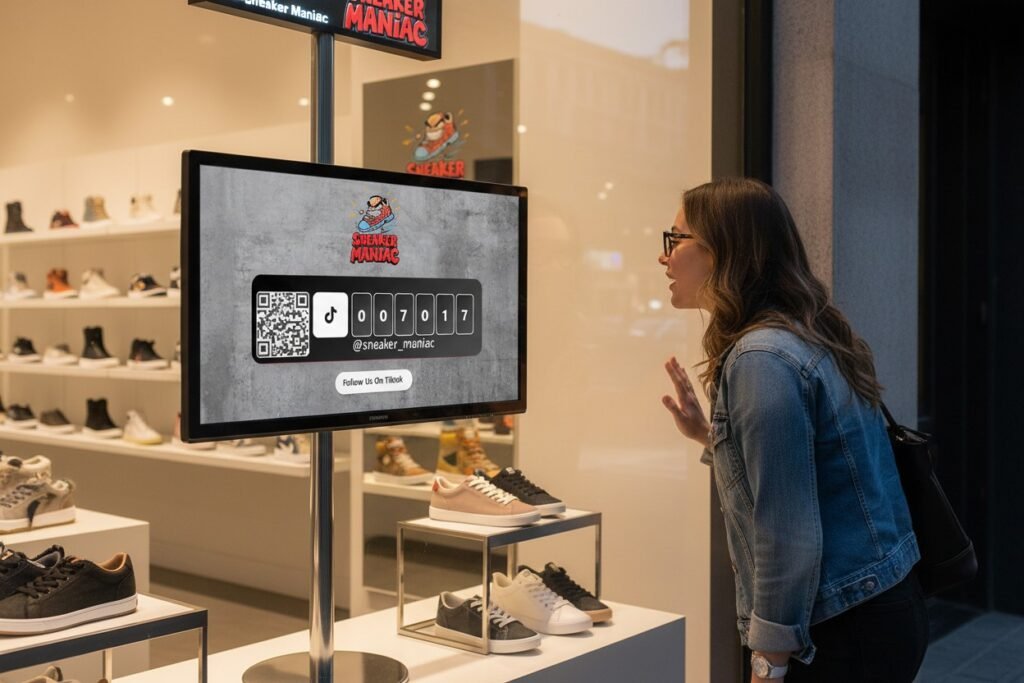
Reducing friction. A QR code next to your display lets someone scan and follow in five seconds. No searching, no typing your handle wrong.
Location matters too. Near the register where people wait. By the entrance where they’re still forming first impressions. Somewhere customers actually look.
The Loop Nobody Talks About
There’s this compounding effect that happens.
You display your reviews. More customers notice your rating. Some of them leave their own reviews. Your review count goes up. More customers trust you because you have more reviews. More of them leave reviews.
It feeds itself.
Same with followers. Visible follower count creates curiosity. People follow. Count goes up. Higher count creates more curiosity. More follows.
Businesses that display social proof tend to accumulate more social proof. The ones that don’t stay stuck.
Different Businesses, Same Principle
The research applies across categories, but the execution varies.
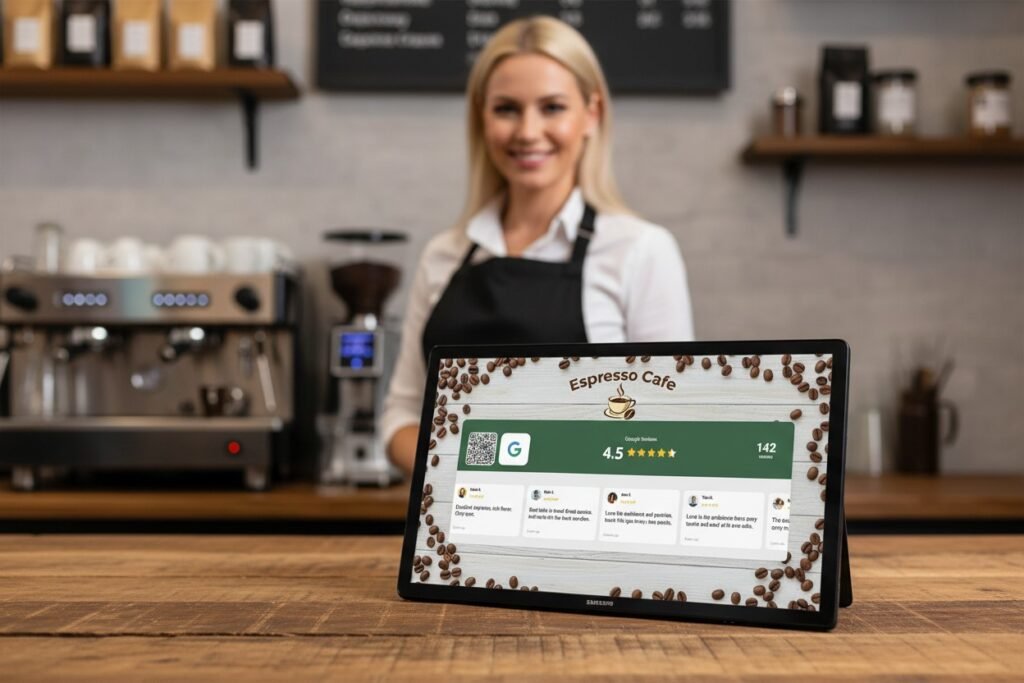
Restaurants have captive audiences. People waiting for tables. People waiting for food. Perfect time to notice a display showing your rating and review count. Perfect time to scan a QR code and leave their own review. More on how to get customers to leave reviews.
Salons and barbershops have really captive audiences. Someone sitting in your chair for an hour isn’t going anywhere. Processing time while waiting for color? They’re on their phone anyway.
Retail catches people at the purchase moment. Someone about to spend money sees your rating behind the register. Validation right when they need it.
The principle is universal. Find where customers wait or linger. Display proof there. Give them an easy action to take.
What to Measure
If you try this, you should probably track whether it works.
Review velocity is the obvious one. How many reviews were you getting per month before? How many after? A jump from 5 to 15 means something.
Follower growth too. Compare monthly new followers before and after.
The Harvard research suggests rating improvements correlate with revenue. So track that if you can. Does a higher rating actually bring more customers?
This stuff compounds slowly. Don’t expect overnight transformation. But over a few months, the differences become clear.
The Bottom Line
Decades of research from serious institutions all points the same direction.
People use social proof to make decisions. 98% read reviews. Trust in strangers’ opinions beats trust in advertising. Higher ratings directly increase revenue.
This isn’t marketing hype. It’s documented, measured, replicated.
The businesses that display their social proof visibly and consistently perform better than those that hide it. Not because they’re necessarily better businesses. Because they’re proving they’re good instead of just claiming it.
Your reviews exist. Your followers exist. Your social proof exists.
The only question is whether customers can see it.
References
- Cialdini, R.B. (1984). Influence: The Psychology of Persuasion. Harper Business. Wikipedia Overview
- BrightLocal. (2024). “Local Consumer Review Survey 2024.” https://www.brightlocal.com/research/local-consumer-review-survey/
- Spiegel Research Center, Northwestern University. (2017). “How Online Reviews Influence Sales.” https://spiegel.medill.northwestern.edu/online-reviews/
- Luca, M. (2016). “Reviews, Reputation, and Revenue: The Case of Yelp.com.” Harvard Business School Working Paper. https://www.hbs.edu/faculty/Pages/item.aspx?num=41233
- Nielsen. (2021). “Global Trust in Advertising.” https://www.nielsen.com/insights/2021/trust-in-advertising-study/
- Leibenstein, H. (1950). “Bandwagon, Snob, and Veblen Effects in the Theory of Consumers’ Demand.” The Quarterly Journal of Economics, 64(2), 183-207. https://www.jstor.org/stable/1882692
- Schwartz, B. (2004). The Paradox of Choice: Why More Is Less. Harper Perennial. TED Talk Summary