
How to Get More Google Reviews for Your Hotel
Guest checks out. Smiles at the front desk. “Loved our stay, we’ll definitely be back!”
And then? Nothing. No review. They vanish.
But that other guest, the one who complained about the air conditioning (which you fixed in ten minutes, by the way), somehow finds time to write four paragraphs about it on Google.
Every hotel knows this pattern. It’s maddening.
The Silent Majority Problem
Happy guests don’t leave reviews. They just… don’t. Not because they’re ungrateful. They’re just busy. They get home, unpack, life takes over. The thought of writing a review never crosses their mind.
Unhappy guests are different. They’re motivated. Frustrated. They want the world to know.
So your Google rating slowly tilts toward the complainers. Not because your hotel is bad. Because the math is broken.
You have to actively fix it.
Wait, What About TripAdvisor?
Yeah, TripAdvisor still matters. Especially if you’re in a vacation destination. People planning trips to Barcelona or Bali absolutely browse TripAdvisor while daydreaming at their desk.
But Google is different. Google is “I need a hotel tonight.” Or “hotels near the airport.” Business travelers. Last-minute plans. Someone whose Airbnb fell through.
These people search Google. They see ratings in the search results. They filter by stars without even thinking about it.
Your Google rating affects whether you show up at all. More reviews, higher rating, more visibility. That’s how local search works.
So yeah. TripAdvisor for the vacation planners. Google for everyone else. You probably need both, but if I had to pick one to focus on? Google.
When to Actually Ask
Checkout is the obvious moment. It’s also kind of terrible.
Think about it. Guest is stressed about getting to the airport. Front desk is juggling three things. Luggage is everywhere. Now you want them to pull out their phone and leave a review?
Not gonna happen.
Better moments exist.
You just solved a problem for them. Room wasn’t ready, you upgraded them. Noise complaint, you moved them to a quiet floor. They’re relieved. Grateful. That’s when you say something like: “Really glad we could sort that out. If you get a chance, a review mentioning how we handled it would mean a lot.”
Or they just gave you a compliment. Unprompted. “This bed is amazing” or “breakfast was incredible.” Don’t just say thanks. Say: “So happy to hear that. We’d love if you shared it on Google whenever you have a minute.”
Catch them when they’re feeling good. That’s it. That’s the whole trick.
The Post-Stay Email
Most hotel follow-up emails are garbage. Sorry, but they are.
“Dear Valued Guest, Thank you for your recent stay at [HOTEL NAME]. We hope you enjoyed your experience and look forward to welcoming you again.”
Nobody reads that. It sounds like a robot wrote it. Which, let’s be honest, a robot probably did.
What actually works is short and human. Something like:
“Hey [first name], hope you made it home okay. If you have 30 seconds, a quick Google review would really help us out. Here’s the link: [direct link to review page]. Thanks for staying with us. – [actual human name]”
That’s it. No corporate fluff. No paragraph about your commitment to excellence. Just a quick ask from a real person.
Send it about a day after checkout. They’ve had time to settle but haven’t forgotten the stay yet.
Put QR Codes in the Rooms
This is weirdly underused.
Small card on the nightstand. “Enjoying your stay? Leave us a review.” QR code that goes straight to Google.
Guests are happiest when they’re in the room. Just took a hot shower. Watching TV in a comfy bed. If they’re ever going to leave a review, that’s the moment.
Some hotels put them by the coffee machine. Some in the welcome folder. Anywhere the guest might be relaxed with their phone nearby.
Costs almost nothing. Takes five minutes to set up. Weirdly effective.
Your Front Desk Staff
They’re the ones who can actually make this happen. Or not.
Most front desk staff feel weird asking for reviews. It feels salesy. Pushy. Nobody taught them how to do it naturally.
So teach them.
Give them a simple phrase. “If you enjoyed your stay, a Google review really helps us out. Totally optional though.” Something they can say without cringing.
And tell them when NOT to ask. Guest is rushing? Skip it. Guest had a complaint? Definitely skip it. Someone checking out at 4am for an early flight? Leave them alone.
Read the room. Ask the happy ones. Let the stressed ones go.
Negative Reviews Happen
You can’t avoid them. Someone will have a bad experience. Maybe it was your fault, maybe it wasn’t. Either way, they’ll write about it.
How you respond matters more than the review itself.
Never argue. Never explain all the reasons they’re wrong (even if they are). The response isn’t for them. It’s for everyone else reading.
Keep it simple: “Sorry we fell short. We’d like to make this right. Please reach out to [contact] directly.”
That’s it. Professional. Takes responsibility. Moves it offline.
People reading your reviews are watching how you handle criticism. A defensive response is worse than the original complaint.
Show Off Your Rating
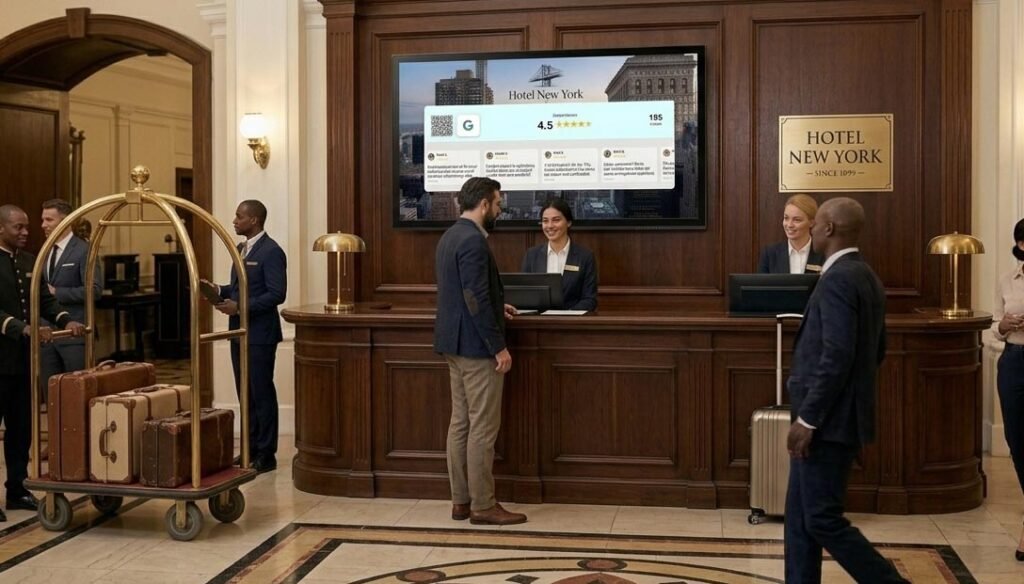
Something kind of cool happens when you display your Google rating in the lobby.
Guests see it when they check in. “4.6 stars from 612 reviews.” It validates their choice. Social proof doing its thing.
But it also plants a seed. All these people left reviews. That’s apparently a thing people do here. Maybe I should too.
Some hotels run a screen showing recent review snippets. “Best hotel I’ve stayed at in years.” “Staff went above and beyond.” It’s a little braggy but it works.
The number becomes a gentle reminder that reviews are expected, normal, part of the experience.
Making It a System
Random efforts don’t work. You need to build this into how your hotel operates.
Post-stay email goes out automatically, 24-48 hours after checkout. Non-negotiable.
QR codes live in every room. Someone checks quarterly that they’re still there and not destroyed.
Front desk knows how to ask. New staff get trained on it during onboarding.
Someone checks Google reviews daily. Responds to everything within a day.
Not complicated. But it requires someone to own it. That’s usually where hotels fail. Not the system. The follow-through.
Start Small
Don’t try to do everything this week.
Today: Make a QR code. Print a few. Put them in your best rooms.
This week: Look at your post-stay email. Is it human? Is it short? Fix it if not.
This month: Talk to your front desk. Give them a phrase. Make it comfortable.
That’s enough to start. Add more later.
The Real Goal
You’re not trying to manipulate your rating. You’re trying to get it to accurately reflect reality.
Your happy guests outnumber the unhappy ones. Probably by a lot. But the unhappy ones are louder. The review system is biased toward complaints.
All you’re doing is giving happy guests an easy way to speak up too.
When both sides are heard, your actual rating emerges. And for most decent hotels, that rating is pretty good.
The ones who don’t do this? They’re stuck with a score that only reflects the complainers. Which isn’t fair to anyone.
