
Nail Salon Marketing. How to Attract More Clients and Build a Loyal Following
A woman walks down a shopping street with chipped polish and ten minutes to spare. She passes two nail salons within a block of each other. One has a “Walk-ins welcome” sign in the window. The other shows its Google rating and a few recent reviews.
She has no way of telling which one sterilises properly, which one does better cuticle work, or whose gel lasts three weeks instead of ten days. So she uses the only evidence available to her, which is what other people said.
That is the whole problem in this trade. Your two biggest selling points, hygiene and skill, are invisible from the pavement. Everything below is about making them visible.
The fear nobody says out loud
Ask around and almost everyone has heard a nail salon horror story. An infection, a fungus, a tool that came out of a drawer instead of a sealed pouch. Those stories travel much further than any good experience does.
Here is what makes it interesting: a new client will never ask you about it. She will not call to ask whether your instruments are sterilised, because the question feels rude. She will just read thirty reviews looking for a reason to worry, and if she finds nothing reassuring she quietly books somewhere else.
So the hygiene conversation happens entirely without you, in your review section, with you not in the room.
Which means every competitor who says nothing about hygiene is leaving the strongest argument in this industry completely unused.
Make the cleaning visible instead of efficient. Most salons sterilise properly and then hide all the evidence. Open sealed pouches at the table, in front of the client, every time. Keep the autoclave where people can see it rather than in the back. Wipe the station down while she is sitting there instead of between clients. Hand her a visibly fresh towel.
None of that costs you anything. You were already doing it. You were just doing it out of sight.
The payoff lands in your reviews. You cannot ask a client to write about hygiene, and you should not try. What you can do is make your standards so obvious that people mention them on their own. A review describing tools coming out of a sealed packet does more work than any “we are clean” sign, because it comes from someone with nothing to sell.
Those are also the reviews that win over the nervous first-timer, who is exactly the client you want, because once she trusts a salon she stops shopping around.
Ask for the review before the polish goes on
This is the part nail salons get wrong more than any other kind of business, and it is almost funny once you see it.
Standard advice says to ask at the end, when the customer is happiest. In a nail salon the end is the one moment she physically cannot do it. Her hands are wet, or under a lamp, or held out like a surgeon walking to the sink. Nobody is typing a review with fresh gel.
By the time her nails are dry she is paying, and then she is gone.
Two timings that do work:
At the start, during the consultation. While you are discussing shape and colour, her phone is in her hand anyway. A small card or QR code at the station is enough. Plenty of people will do it right there, because walking in was already a vote of confidence.
Two to four hours later, by text. This is the strongest one for nail work specifically. By then she has shown her friends, had the compliments, and taken three photos in different light. She is at the peak of being pleased with her hands, and her hands are free.
Hi [name], thanks for coming in today. Hope you are getting compliments. If you have a minute, a Google review really helps us: [link]
Short, no discount, no second reminder.
What to avoid: asking while she is paying, because she is thinking about her card and her next appointment. And never asking only the clients you expect to be positive. That is review gating, it breaks Google’s rules, and it can cost you the reviews you already have.
The wording and timing of the ask are covered in how to get customers to leave reviews on Google. Our free Google review QR code generator makes the code for the station.
Why review count matters as much as the rating
Worth knowing before you start guarding a perfect average: in local search, volume carries real weight. A salon with 4.7 stars from three hundred reviews will often sit above one with 4.9 from forty, because the bigger number reads as an established business rather than a lucky streak.
That changes the goal. You are not protecting a score. You are collecting steadily, every week, for years.
It also means the occasional four star review is not the disaster it feels like. A profile with nothing but fives reads as suspicious to a surprising number of people. A few imperfect reviews with sensible replies underneath look like a real business, which is what you are.
Reply to everything, especially the bad ones. A calm, specific reply to a complaint is read by far more people than the complaint itself, and it tells every future client what happens if something goes wrong.
Your window is a shop assistant that works at night
Nail work is often an impulse decision. She did not plan this. She noticed her hands and she is walking past right now.
In the few seconds she looks at your salon she is answering four questions: is this place any good, is it clean, is it busy, and can I get in today.
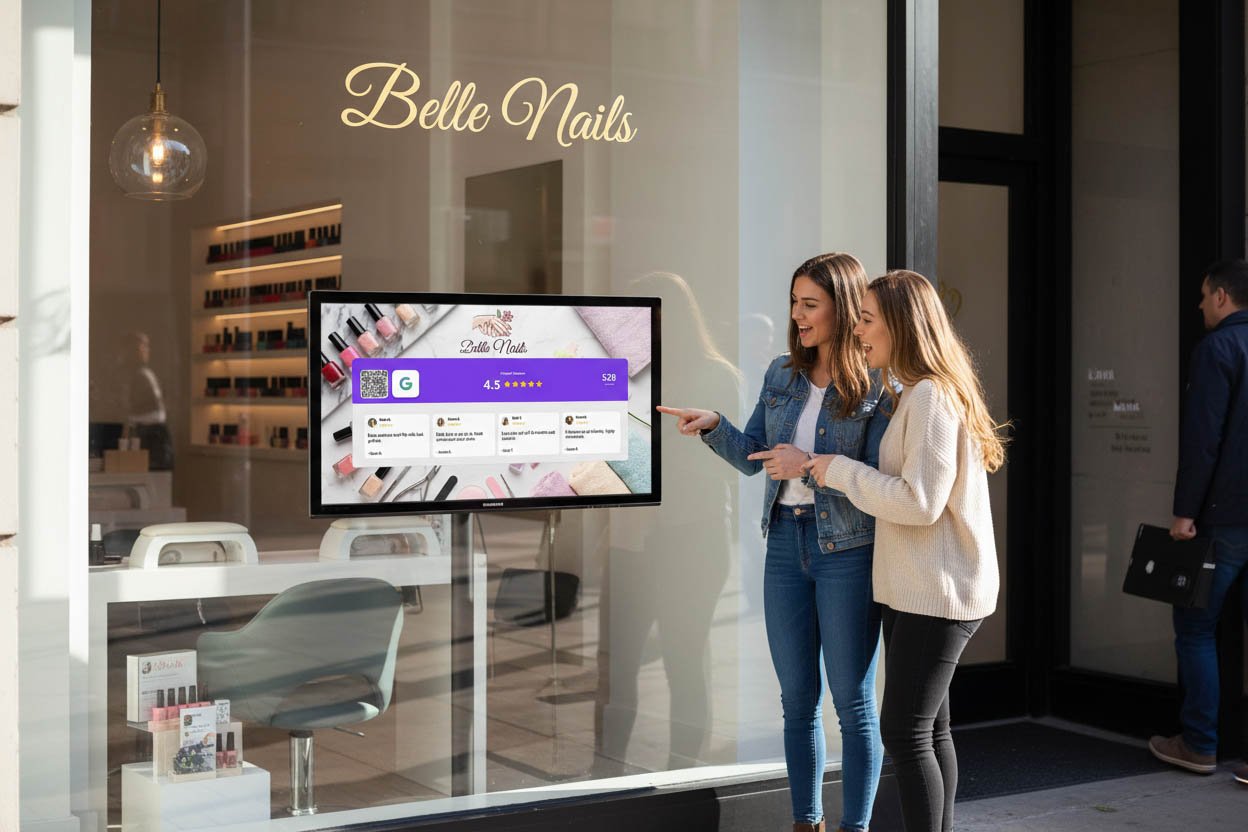
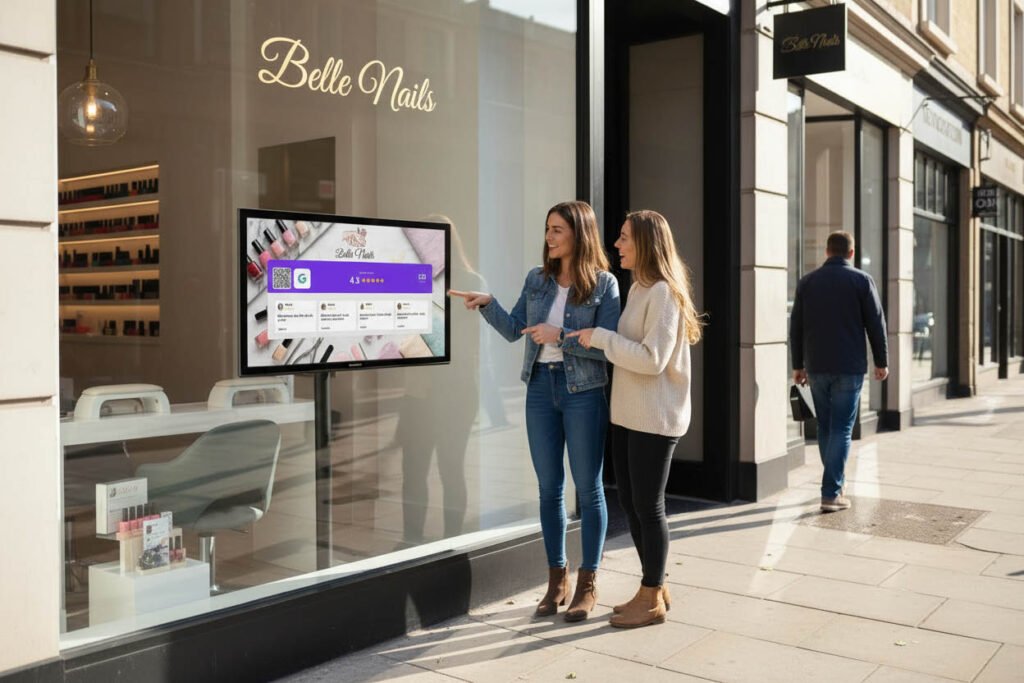
A faded “Open” sign answers none of them. A screen in the window showing your live rating, your review count and a few recent reviews answers the first one instantly, and photos of your work answer the next two by implication.
Add your current wait time if you can manage it, even on a small board written by hand. “Walk-ins welcome, about 20 minutes” converts better than “Walk-ins welcome”, because it removes the fear of standing there awkwardly while nobody looks up.
This is also the only part of your marketing that works at ten at night, when you are closed and she is walking home deciding where to go on Saturday.
Full disclosure: SocialCounters is our product, and it puts your live Google rating and follower counts on any screen you already own. The cheap way to test whether a window display would do anything for you is to print your rating on a card this week and watch whether anyone mentions it. If nothing changes, a screen will not change it either. Why visible numbers shift behaviour is covered in the science of social proof.
Instagram is your portfolio, not your diary
Of every local trade, nail work is the one made for Instagram. The product is already designed to be photographed.
What actually earns follows:
Close-ups in decent light. Daylight near a window beats any ring light. A blurry photo of excellent work loses to a sharp photo of average work, which is unfair but true.
Deliberate variety. Someone checking you out before booking is asking one question: can they do the thing I want. Five almond gel sets in a row answers that for one person and nobody else. Mix the shapes, lengths, colours and art levels.
Process video. The filing, the sweep of colour, the chrome powder going on. These travel further than finished shots because they are pleasant to watch even for people who will never book you.
Your technicians by name. Clients follow people, not salons. “French tips by Maria” with her own tag builds a following attached to someone who works for you, which is also how you keep good staff.
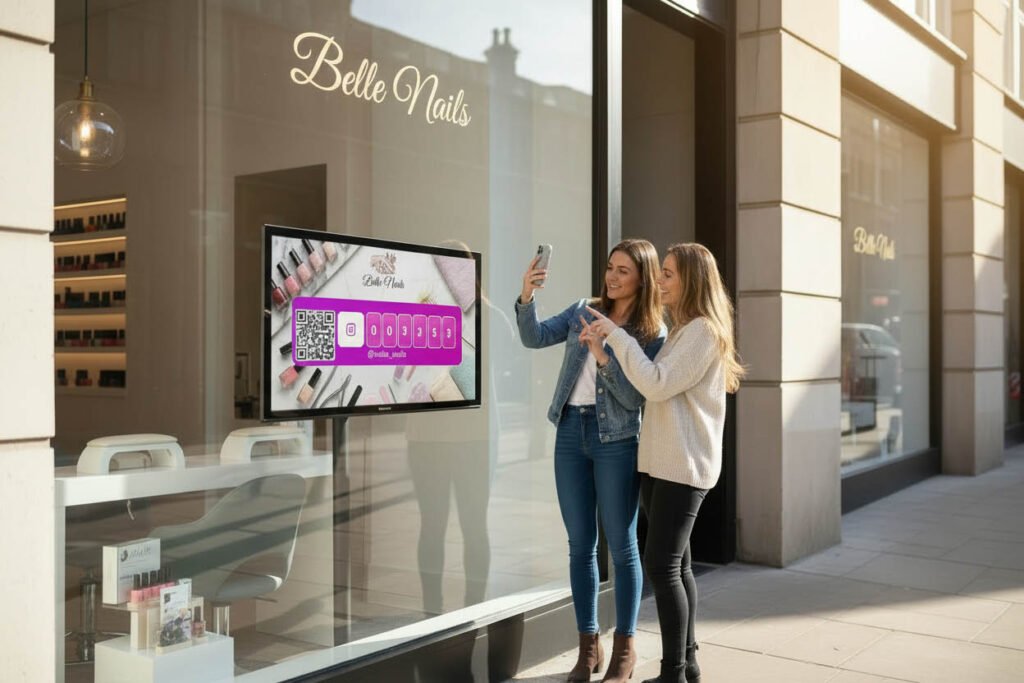
A note on the drying minutes: those ten minutes with her hands under a lamp are the most wasted time in the whole salon. She is bored, she cannot touch her phone, and she is looking at whatever you put in front of her. That is the moment for your feed or your reviews on a screen at the station. She cannot scan, but she can read, and she remembers.
Where the money actually leaks
Three habits cost nail salons more than any marketing gap.
Competing on price. Discount hunters leave for the next discount. You cannot build a book on them, and they are the hardest clients to please, because price was the only reason they came.
Not rebooking at the table. A fill is due in two to three weeks and you both know it. “Shall I put you in for the twelfth?” while she is still in the chair is worth more than any campaign and costs one sentence.
Letting the seasons surprise you. Valentine’s, prom and graduation, wedding season, the week before Christmas and New Year’s Eve are predictable rushes. Those are your highest traffic weeks, which makes them your best review weeks. Send the follow-up text religiously then and your review count climbs in steps instead of a trickle.
What to do first
If you do one thing from this article, make your hygiene visible and let your clients write about it. It is free, you are already doing the work, and it is the one argument your competitors are not making.
If you do two, add the follow-up text a few hours after the appointment. It is the highest-return habit in this trade, because it catches people at the exact moment they are being told their nails look great.
Everything else, the window screen, the feed, the loyalty card, works better once those two are running. Reputation first, display second. A screen showing forty reviews is not worth much. A screen showing three hundred sells for you while you are busy doing someone’s cuticles.
