
Instagram for a Women’s Fashion Boutique. Sell the Outfit, Not the Rail
Open the Instagram of ten clothing boutiques and nine of them look the same. A dress on a hanger. A blouse against a white wall. A pair of jeans folded on a wooden surface. Clean, well lit, competent, and completely forgettable.
That is a catalogue. Catalogues do not build anything, because nobody has ever decided to follow a catalogue.
The boutiques that grow on Instagram are not the ones with the best photography. They are the ones who worked out that their stock is not the product. The outfit is the product, and the customer standing in the fitting room is the content.
This is written for womenswear specifically, because fashion retail has three things almost no other local business has: a fitting room, a seasonal rhythm, and customers who already take photos of themselves inside your shop.
Nobody buys a dress
Most boutique feeds make the same mistake. You post the item because the item is what you paid for. But your customer is not shopping for a floral midi dress. She is shopping for the moment she walks into a restaurant and knows she looks good, and for the compliment her friend will give her.
Which is why one item photographed three ways beats three items photographed once.
Take that floral midi. Shoot it with trainers and a denim jacket. Shoot it with a blazer and flats. Shoot it with heels and gold jewellery. Same dress, three different women imagining three different evenings. The one who would never have looked twice at it for the office now sees it as an office dress.
Those three photos also do something a single product shot cannot: they tell a customer you know how to dress her. That is the whole reason she comes to a boutique instead of ordering online.
Who models matters less than you think. Your staff can do it. Regular customers are often delighted to be asked, and their friends follow the account just to see the post. A phone photo of a well-styled outfit beats a studio shot of clothes on a rail every single time.
Write captions that ask something. “One dress, three ways. Which one would you wear?” gets comments. Comments tell Instagram that people care, and the algorithm hands you reach in return. “New arrival, size 36 to 42, link in bio” gets silence.
The fitting room is your studio
This is the part most boutiques never think about, and it is the one that actually separates you from a webshop.
The fitting room is where the decision happens. She is standing there with her phone, texting a photo to a friend, taking a mirror selfie to see the back, hesitating between two sizes. That behaviour already exists in your shop today. Most boutiques have a fluorescent tube and a smudged mirror and quietly ruin every photo that gets taken in there.
Three things fix it, none of them expensive:
Light that does not make people look grey. A ring light or two warm LED strips either side of the mirror, at face height, never above. Overhead light puts shadows under the eyes and kills the colour of the fabric. This single change improves every photo your customers already take.
A background worth photographing. A painted wall in one strong colour, a curtain in a decent fabric, anything other than a half open door and a pile of hangers.
Your handle where the mirror is. Small, tasteful, and next to it a QR code so nobody has to type anything. Not a laminated A4 shouting “FOLLOW US”.
Then make it worth her while. Give the shop a hashtag that is actually yours, offer ten percent off for a fitting room photo that tags you, and repost the best ones with permission.
What you get back is worth more than the discount. You get photographs of your clothes on real bodies of different shapes, which you did not have to produce, could not have faked, and which sell better than any model shot because other women can see themselves in them.
A weekly feature works well here: the same piece on three different customers with three different builds. It shows the garment is forgiving, and it makes the women in the photos feel seen, which is how you turn a buyer into a regular.
One practical note that boutiques forget: get permission in writing, even if it is just a reply in DM. Reposting someone’s face without asking is the fastest way to turn a happy customer into an angry one.

Seasons are a content calendar you already own
Fashion retail has a rhythm almost no other local business has, and it maps perfectly onto Instagram.
The week new stock lands is a content week. The changeover from summer to autumn is a story. Sale season has a built-in countdown. Wedding season, festival season, back to school, the first cold morning: every one of those is a reason to post that your customers are already thinking about.
Film the unboxing. Boxes arriving, pieces coming out, the first thing you hang on the rail. It is unglamorous and people love it, because it feels like being there before everyone else.
Post the thing before it hits the floor. “On the rail tomorrow at ten” does two jobs at once: it rewards the people who follow you and it gets someone through the door on a Tuesday morning.
Show what sold out. “This went in two days, more coming Thursday” is social proof, scarcity and an invitation in nine words.
Your bag walks around town
A paper bag with your name on it travels through the city centre, sits next to someone at a café table, and goes home on the tram. It is the cheapest advertising you will ever print, and most boutiques waste it by putting the handle in six point type on the bottom seam.
Put it on the front, big enough to read from across a table.
The insert in the bag is even more underused. A small card that says “Show us how you style it” with your handle beats “Follow us on Instagram”, because one invites her into something and the other asks her for a favour.
And when a customer does post, reply like a human being. Not “thanks!” but something about the actual outfit, like the fact that she wore it with boots instead of the heels you expected. That is the difference between an account that feels like a shop and one that feels like a person with taste.
Local accounts beat big influencers
You do not need a name with fifty thousand followers who lives two hundred kilometres away. You need five women with two thousand followers who live in your city and whose friends recognise the street in the background.
Judge them on engagement, not on follower count. An account where fifty people comment on every post has an audience. An account with fifty thousand followers and eleven likes has a graveyard.
When you approach them, do not send a pitch. Send something specific about their style, offer a few pieces from the new collection, and say there is no obligation to post. Most will post anyway, and it will look like a recommendation instead of an advert, because that is what it is.
A small group on quarterly store credit with early access gives you the same effect all year, and costs less than one boosted post a month.
The people in your shop right now
Everything above is about reaching people who are not in your shop. This last part is about the ones who are.
Most of them will leave without following you. Not because they did not like it, but because following requires remembering your handle, opening the app, typing it correctly and searching. By the time she is on the street, the moment has gone.
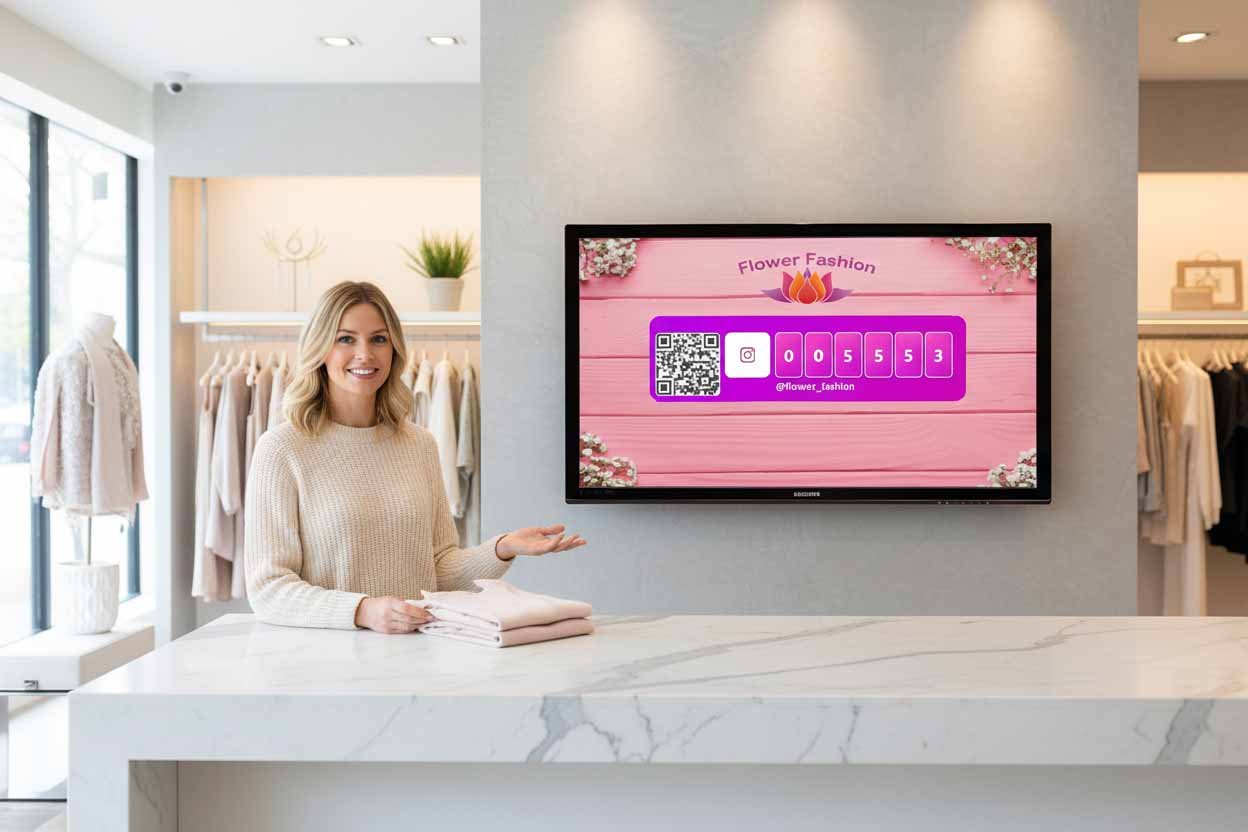
A screen near the till or the fitting rooms showing your live follower count removes all of that. The number does the convincing, the QR code does the work, and it takes her ten seconds while she waits.
The fitting room is the better spot of the two, for the same reason as everything else in this article: her phone is already in her hand.
A small push helps. “Follow and show it at the till for fifteen percent off today” pays for itself the first time she comes back because she saw your new arrivals in her feed. A customer who does not follow you has to be won again from scratch every season.
Full disclosure: SocialCounters is our product, so of course we think the screen belongs in your shop. The honest way to test it is free: make a code with our follow us QR code generator, put it on the fitting room wall for two weeks and count what comes in. If a piece of paper does nothing, a screen will not change that.
The general version of this idea, for any kind of shop, is in how to turn foot traffic into social media followers and the science of social proof. If you are starting from close to zero, read how local businesses get their first 1,000 Instagram followers first.

What to measure
Not follower count. A thousand women who live within twenty minutes of your door are worth more than ten thousand accounts in another country who will never stand in your fitting room.
Watch these instead: how many story views come from local accounts, how many people reply to your stories, how many fitting room photos get posted in a month, and how often someone at the till says she came because of something she saw on Instagram. That last one is the only number that pays your rent.
Your taste is already the reason people come in. The work is to stop letting them walk out disconnected.
