
How Smart Laundromat Owners Turn 45 Minutes of Waiting Into 5-Star Reviews
A laundromat owner in Houston told me something that stuck with me. She said the biggest change in her business over the past three years wasn’t the new high-efficiency machines. Wasn’t switching to cashless payments. It was what she put on the wall above the folding tables.
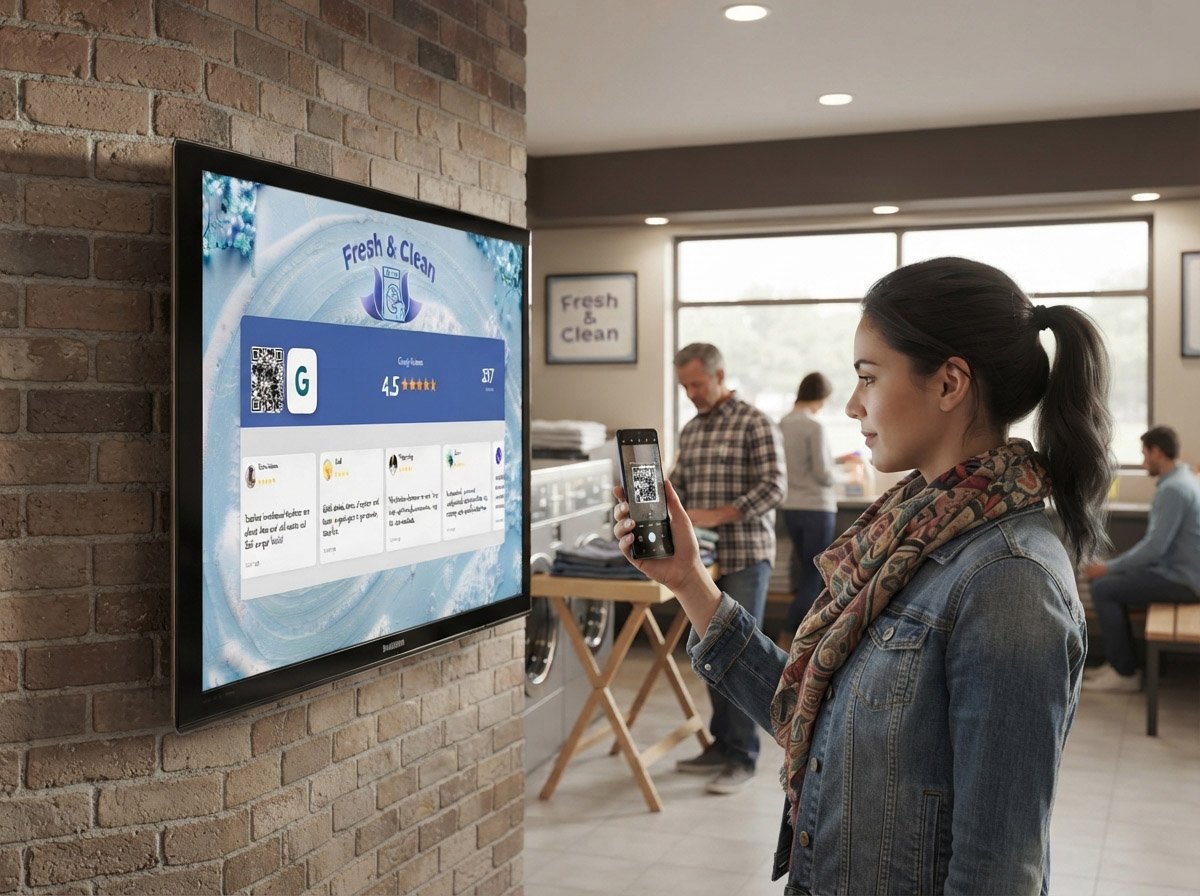
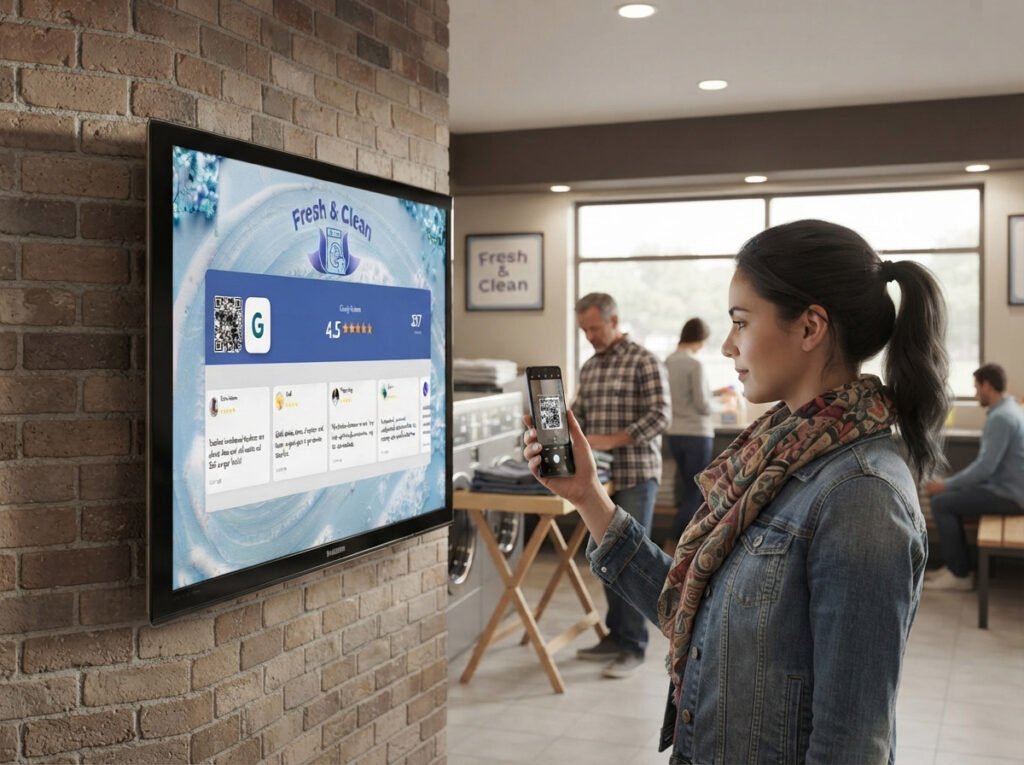
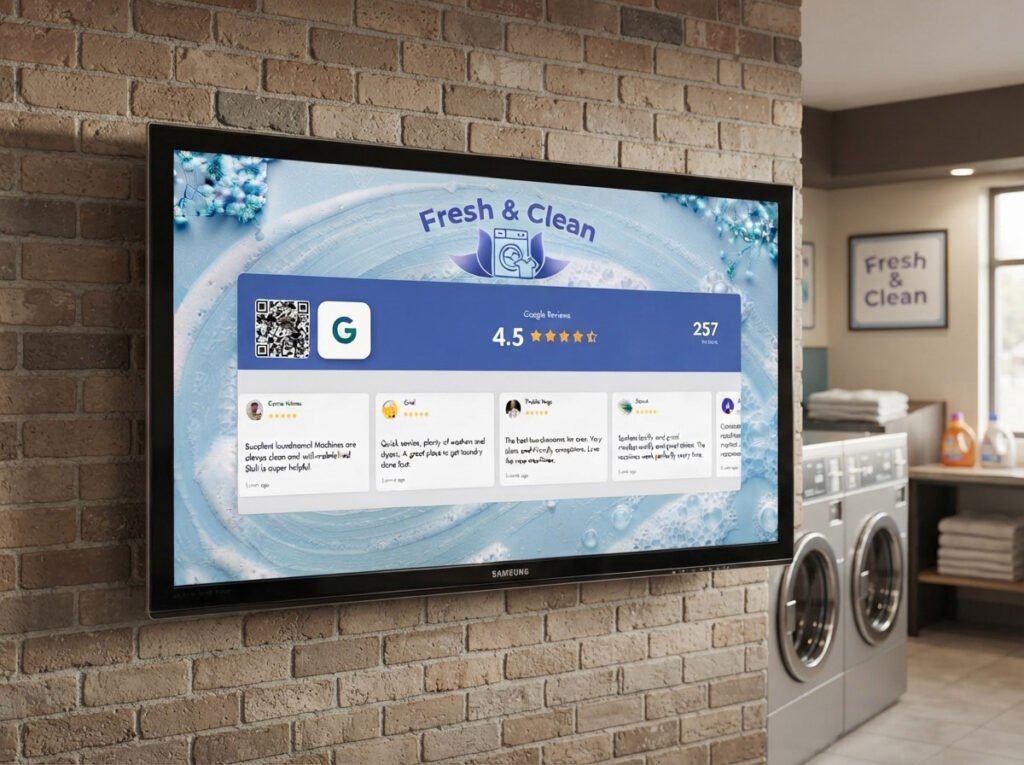
A screen showing her Google reviews. Live. Rotating. Updated in real time.
Her wash-and-fold orders went from two per week to two per day within a month. “Even the smallest amount of work we did on Google reviews made a thousand dollars difference,” she said. “That alone made us more money in the last month than in any of our previous four years of operation.”
The 45-Minute Window Nobody Talks About
The laundromat industry hit $22.6 billion in 2026. But here is what most owners miss: the single biggest marketing opportunity in this business is the 45 to 60 minutes your customers spend inside your walls, every single week, doing absolutely nothing.
Think about what happens during a typical visit. A customer loads their clothes. Waits. Transfers to the dryer. Waits again. Folds. The entire time, they are sitting in plastic chairs or standing by the machines, phone in hand, half-watching whatever happens to be on the TV.
This is a captive audience. The kind you normally pay thousands for. An audience that literally cannot leave for the next 45 minutes.
Most laundromat owners waste this completely. They play cable news or run the same loop of machine maintenance videos nobody watches. Meanwhile, their competitors are building review counts that pull customers straight from Google Maps.
Why Reviews Hit Different for Laundromats
When someone searches for a laundromat, they are not browsing. They need one. Today. Probably within the next hour.
And when three laundromats show up on Google Maps, the decision comes down to two things: distance and reviews. You cannot control distance. Reviews, though. Those you can absolutely control.
Social proof psychology explains why this works. People trust what other customers say about a business far more than what the business says about itself. For laundromats, this effect is even stronger. Nobody dreams about visiting a laundromat. It is a chore. So when a potential customer sees that 200 other people had a decent experience at your location, that is permission to stop searching.
The challenge is that laundromats have traditionally been terrible at collecting reviews. The experience is functional. Nobody finishes folding their towels and thinks, “I should really tell Google about this.” The moment passes. The review never happens.
Unless you engineer the ask into the experience itself.
Displaying Reviews Creates Reviews
Here is the counterintuitive part. Showing your existing reviews on a screen in your laundromat does more than impress new customers. It triggers more reviews from your regulars.
When someone sees a wall of five-star reviews from people just like them, something shifts. They realize that leaving a review is normal. Expected, even. And they start paying attention to their own experience differently. That clean folding table they usually ignore? Now it registers as something worth mentioning.
This is how review collection actually works in physical spaces. People join behaviors when they see evidence that others have done it before them. A QR code on a laminated sign by the register asks customers to leave their comfort zone. A rotating display of real reviews shows them they would be joining a crowd.
The Houston owner added a simple QR code near her review display. Nothing aggressive. Just visible. “Happy with your visit? We’d love to hear about it.” Her review count doubled in 30 days.
The Unattended Model Changes Everything
The industry is shifting fast. Unattended, 24/7 laundromats are becoming the default. Smart lockers for wash-and-fold pickup. App-based payments. No staff on site.
This creates a marketing problem. If nobody is there to ask for reviews, how do you get them?
Your physical space has to do the asking for you. A screen showing live reviews and a QR code for leaving one works around the clock. No staff required. No awkward conversations. The system runs whether you are there at 2pm or the customer shows up at 2am.
For operators running multiple locations, this scales in a way that hiring someone to ask for reviews never could.
Beyond Reviews: Building a Following
Reviews are the foundation. But customers who visit your laundromat every week are potential followers too.
When you convert regular foot traffic into social media followers, you get a direct line to announce extended hours. New equipment. A temporary closure for maintenance. Holiday specials on wash-and-fold.
The laundromats repositioning themselves as community spaces – seating areas, free WiFi, small café counters – have figured out that their customers are spending real time in a physical location, regularly, for years. That is a relationship worth investing in.
A display showing your Instagram follower count and a QR code linking to your profile turns passive visitors into connected customers. Not because they love laundry. Because they want to know when the new dryers arrive.
Static Signs Do Not Work Anymore
Walk into almost any laundromat and you will see the same laminated signs that have been there for a decade. “Please clean lint trap.” “Not responsible for lost items.” Maybe a faded “Review us on Google” card that someone printed in 2019.
Nobody looks at these anymore. They are part of the wallpaper.
The difference between a static sign and a live display showing real reviews is the difference between a poster and proof. One is decoration. The other updates in real time. When your review count moves from 127 to 128 because someone just left feedback, that movement matters. It signals that this is happening now. That the business is alive.
Timing the Ask
The moment a customer decides whether to leave a review is not when they arrive. It is in the final ten minutes of their visit. The laundry is clean. The folding is done. They are about to leave, feeling that small satisfaction of a completed task.
This is exactly when your review request should be visible. Not at the entrance. Not hidden by the vending machines. Right where they stand for those last few minutes, getting ready to go.
The psychology of review timing works the same way here as anywhere else. Catch people at peak satisfaction. Make the action easy. A QR code that opens directly to your Google review page, placed at eye level near the folding stations, converts better than a URL on a business card. One scan. Two taps. Done.
What the Best Operators Are Doing
The laundromats pulling ahead right now share a few characteristics. Modernized payments. Machine availability apps. Wash-and-fold as an upsell.
But the ones growing fastest have figured out something else. Their biggest untapped asset is the time customers spend inside. They are treating 45 minutes of attention as something to monetize, not minimize.
A screen showing live reviews, a QR code for leaving one, social follower counts. None of this requires staff. None of this interrupts the customer experience. It just runs, quietly converting every visit into potential social proof.
The Houston owner is planning permanent wall placards now. QR code cards near every machine. Review displays at both entrances. “This wasn’t magic,” she said. “Clarity. Consistency. Follow-through.”
The Compound Effect
A laundromat with 50 reviews and a 4.2 rating shows up lower in Google Maps than one with 200 reviews and a 4.6. Every review you collect today makes tomorrow’s customer more likely to find you.
This is infrastructure. The systems you put in place now will keep generating reviews long after you stop thinking about them.
And unlike paid advertising, which stops the moment you stop paying, review counts go up and stay up. Every satisfied customer who scans that QR code adds permanent proof that your laundromat is worth choosing.
The question is whether you build that system today, or keep letting 45 minutes of captive attention walk out the door with nothing to show for it.
