
Instagram Growth for Women’s Fashion Boutiques
A boutique owner in Amsterdam told me she gained more followers from one fitting room mirror than from six months of product photography. The mirror had good lighting, a small sign asking customers to tag the store, and a QR code. That was it.
She was posting the same flat lays as everyone else. Clothes on hangers. Items against white backgrounds. Professional-looking, technically competent, utterly forgettable. Her feed looked like a catalog, and catalogs don’t build communities.
The shift happened when she stopped thinking about Instagram as a place to display inventory and started thinking about it as a place to capture moments that were already happening in her store.
The Outfit Problem
Scroll through most boutique Instagram accounts and you’ll see individual items. A dress. A blouse. Jeans. Each photographed in isolation, each posted with a caption announcing its arrival.
But nobody buys a dress. They buy the feeling of walking into a restaurant and knowing they look good. They buy the compliment they’ll get from a friend. They buy a version of themselves they want to become.
When you photograph a floral midi dress three ways, casual with sneakers, office-ready with a blazer, evening-appropriate with heels, you’re not selling one item. You’re selling three fantasies. The customer who would never have considered that dress for work suddenly sees it differently.
Your staff can model. Loyal customers often love being featured, and their friends follow just to see the post. The production value matters less than the styling intelligence. A phone photo of a well-styled outfit beats a professional shot of clothes on a hanger.
Captions should invite participation. “One dress, three ways. Which would you pick?” generates comments. Comments signal to Instagram that people care. The algorithm rewards engagement with reach.
Fitting Rooms as Content
The fitting room is where purchase decisions actually happen. Customers stand there, phone in hand, texting friends for opinions, taking mirror selfies to evaluate outfits from different angles. This behavior already exists. Most boutiques ignore it completely.
Making a fitting room Instagram-friendly requires minimal investment. A ring light improves the photos customers are already taking. A clean background helps. A small sign with your handle plants the idea. A QR code removes the friction of searching.
The real opportunity is user-generated content. Create a hashtag specific to your store. Offer a small incentive, maybe 10% off, for customers who post fitting room photos. Then repost the best ones with permission.
This accomplishes several things simultaneously. You get authentic content showing your clothes on real bodies. You demonstrate body diversity without having to produce it yourself. You build community among customers who see each other featured. And you create social proof that attracts new followers.
Some boutiques run weekly features styling the same piece on different body types. This shows versatility while making customers feel represented. The piece sells better because more people can envision themselves in it.

Converting Foot Traffic
The customers walking through your door have already done the hard part. They found you, they’re interested, they’re physically present. Most of them will leave without following you online because you’re asking them to remember later, and later never comes.
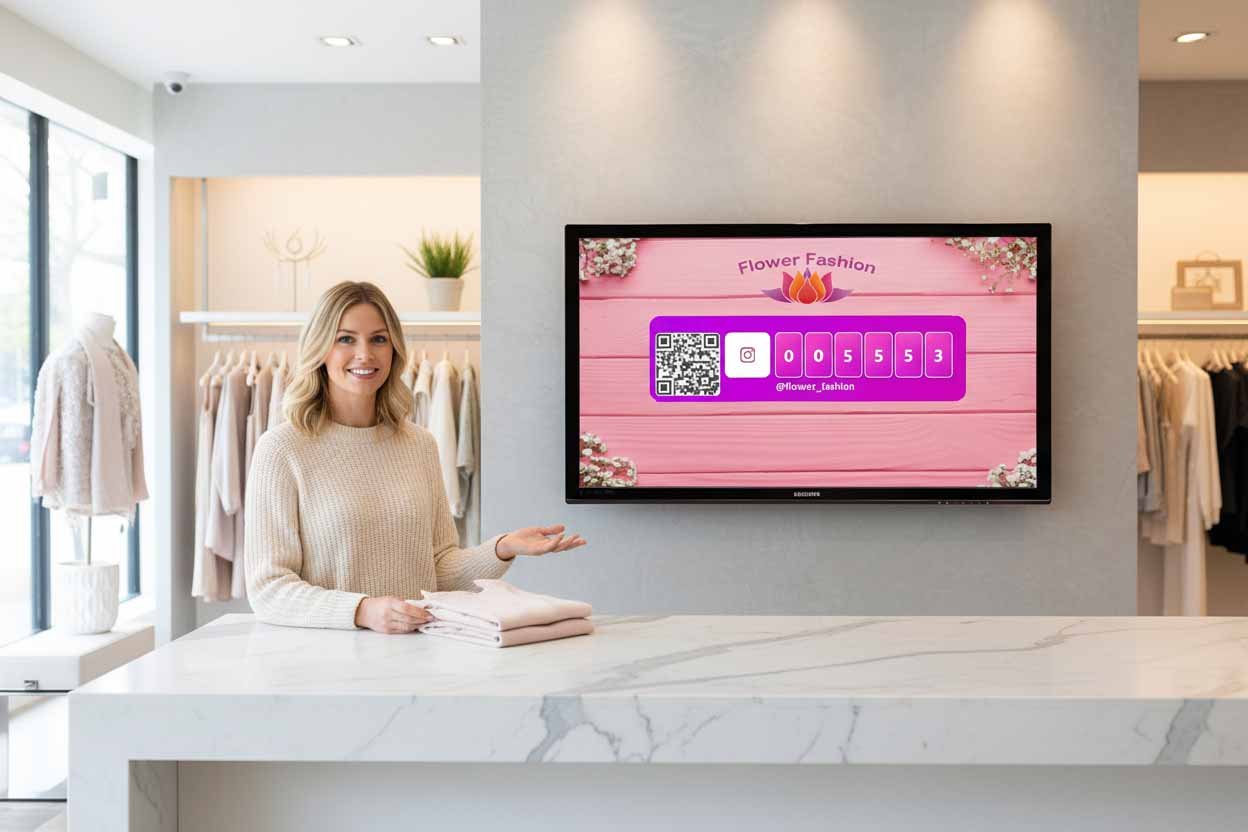
A screen near the register or fitting rooms showing your follower count changes this dynamic. The number itself creates credibility. Four thousand followers signals that this boutique matters, that other people think it’s worth following. The QR code beside it removes every obstacle between intention and action.
The fitting room placement works particularly well. Customers sit there, phone already in hand, waiting to see how something looks. A QR code on the wall takes three seconds to scan. Compare this to hoping they’ll remember to search for your handle when they get home. They won’t.
Consider sweetening the offer. Follow and show at checkout for 15% off today. The discount pays for itself through the repeat visits that come from staying connected. A customer who follows you sees your new arrivals, your styling ideas, your sale announcements. A customer who doesn’t is a customer you have to re-acquire from scratch.
Local Influence Over Celebrity Reach
You don’t need famous influencers. Local accounts with a few thousand engaged followers often deliver better results because their audience actually lives nearby. Someone with 5,000 followers and genuine engagement beats someone with 50,000 followers and anemic interaction.
Look at engagement rates, not follower counts. An account averaging 10% engagement has an audience that actually pays attention. An account with 1% engagement has mostly ghosts.
The approach matters. Don’t pitch immediately. Reach out personally with something specific: “We love how you style oversized blazers. We’d like to gift you a few pieces from our new collection. No pressure to post.” Most will be flattered. Most will post organically because they genuinely like what they received.
For ongoing relationships, select a small group and give them quarterly store credit plus early access. In exchange, they post regularly and their followers learn about you through someone they already trust.
Story takeovers work too. Let someone with aligned style take over your Stories for a day, styling their favorites from your inventory. Their audience gets introduced through a familiar voice.
Touchpoint Accumulation
Your shopping bags travel. Customers carry them down the street, into cafes, onto public transit. Make sure your Instagram handle is visible, not buried in small print but prominent enough to read at a glance.
Same principle applies to receipts, fitting room mirrors, the checkout counter, window displays. Each touchpoint plants the idea. No single one converts everyone, but accumulated exposure adds up.
The shopping bag insert is underutilized. A small card with “Show us how you style it” and your handle. Not demanding, just inviting. Customers who feel like they’re joining a community rather than doing you a favor are more likely to participate.
When customers do post, engage meaningfully. Not generic thanks but actual observations about their styling choices. This makes them feel seen. It makes them likely to do it again. It signals to their followers that your account is responsive and human.
Follower-Exclusive Events
Most boutiques host open events. Anyone can come. This works fine, but it doesn’t give people a reason to follow.
Events restricted to followers create that reason. Early access to new arrivals, followers can shop twenty-four hours before items hit the floor. Private styling sessions. Story-only promo codes.
Promote these exclusively on Instagram. Countdown stickers build anticipation. Make the exclusivity clear and genuine. Customers who aren’t following will follow immediately when they realize they’re missing something.
Document the events in real time. The crowd, customers discovering pieces, excited moments. This creates urgency for those who missed it. They won’t miss the next one.

What Actually Matters
A thousand engaged local followers who visit your store, share your content, and bring friends are worth more than ten thousand random accounts who will never set foot in your space.
The metrics that matter are engagement rate, story views from local accounts, and most importantly, customers who mention they saw something on Instagram. Track those, not raw follower count.
Your curation is already good. Your styling expertise already exists. The challenge is capturing connection with people who are already interested rather than letting them walk out disconnected.
Make following effortless. QR codes where customers naturally have their phones out. Handles on everything they take home. Screens showing live counts that signal credibility.
The customers are already there. The interest already exists. You just need systems that capture it instead of hoping people remember to find you later. They won’t remember. Make it easy now.
